
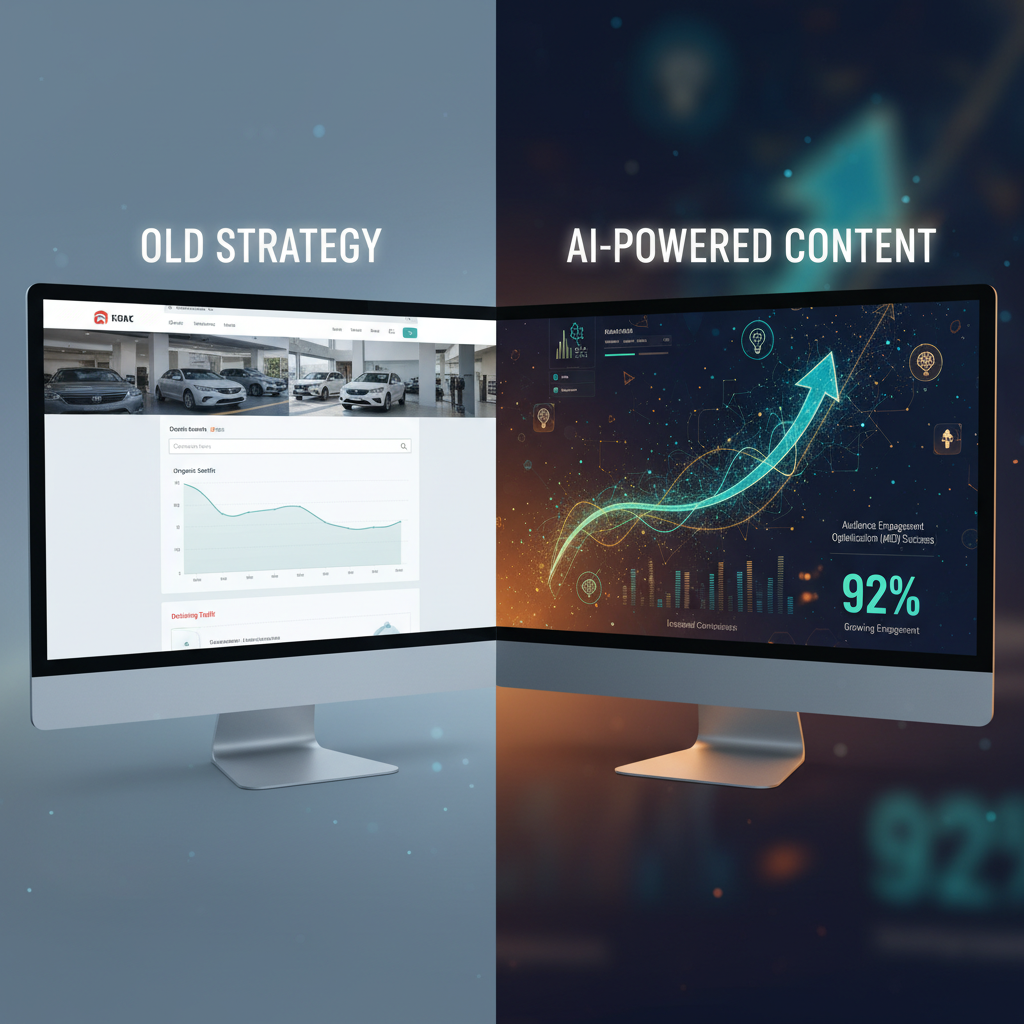
Car dealerships across the United States are facing declining organic traffic as AI features change search results. Despite the vast majority of car buyers researching online before purchasing, dealership websites are seeing dramatic declines in organic visits as AI-powered search results increasingly answer customer questions directly without requiring site visits. With 58.5% of U.S. searches resulting in zero clicks, traditional SEO strategies are no longer sufficient. The solution lies in Answer Engine Optimization (AEO) – a specialized approach that positions your dealership as the authoritative source within AI-generated responses. Demand Local’s LinkOne Data platform provides the technical foundation needed to implement effective AEO strategies by connecting your inventory and customer data to create accurate, authoritative content that AI systems prioritize.
Key Takeaways
- 58.5% of searches result in zero clicks, with only 360 clicks per 1,000 searches reaching the open web
- AI Overviews appear for a meaningful share of queries and can significantly reduce click-through rates to dealer websites
- Passing all Core Web Vitals on mobile remains challenging across many industries, creating a massive competitive opportunity for dealerships that optimize performance
- Car buyers increasingly use AI tools like ChatGPT for vehicle research, and voice search usage continues to grow on mobile devices
- Informational landing pages are more frequently cited in AI Overviews than vehicle detail pages, making educational content essential
- A notable share of AI-triggering queries relate to service and maintenance, representing an untapped opportunity for fixed ops traffic
Why Dealership Traffic Is Declining in 2025
The automotive digital marketing landscape has undergone a fundamental transformation that has left most dealerships struggling to maintain their organic traffic. This isn’t just a minor algorithm update—it’s a complete paradigm shift in how consumers find information and make purchasing decisions.
The Shift from Traditional Search to AI-Powered Answers
Google’s introduction of AI Overviews has dramatically altered the search experience. Rather than presenting a list of websites for users to click through, Google now provides direct answers synthesized from multiple sources. This change means that even if your dealership ranks #1 for a traditional keyword, you might not receive any traffic if Google’s AI can answer the question without requiring a site visit.
The data is stark: AI Overviews appear for a meaningful share of queries, and when they do appear, they can significantly reduce click-through rates compared to traditional results. This represents an existential threat to dealership marketing strategies built entirely around traditional SEO tactics.
How Zero-Click Results Hurt Dealership Websites
- The zero-click search phenomenon has reached crisis levels for automotive retailers. With 58.5% of searches resulting in zero clicks, consumers are getting their questions answered directly in the search results without ever visiting dealership websites.
- This trend was accelerated by Google’s Helpful Content Update, which devalued websites with thin, manufacturer-description content that doesn’t provide unique value to users. Some automotive sites saw major declines in organic traffic, creating a perfect storm of declining visibility and traffic.
- The situation is particularly challenging because a majority of car-shopping research involves mobile devices, yet passing Core Web Vitals on mobile remains challenging across many industries. This technical deficiency compounds the traffic problem, as slow-loading sites face additional ranking headwinds while also suffering from high bounce rates.
What Is Answer Engine Optimization (AEO) and Why It Matters for Auto Dealers
Answer Engine Optimization (AEO) represents the evolution of SEO specifically designed for the AI-powered search landscape. Rather than optimizing solely for traditional search rankings, AEO focuses on structuring content so that AI systems recognize your website as the most authoritative source to cite in their responses.
AEO vs. Traditional SEO: Key Differences
Traditional SEO focused on keyword density, backlink quantity, and technical site structure. AEO, by contrast, emphasizes:
- Answer quality: Providing comprehensive, accurate responses to user questions
- Content structure: Organizing information in formats AI systems can easily extract
- Entity recognition: Ensuring your dealership is recognized as an authoritative entity
- Semantic relevance: Using natural language that matches user intent rather than keyword stuffing
- Structured data: Implementing schema markup that helps AI understand your content
The goal shifts from “ranking on page 1” to “being cited as the source within AI-generated answers.” This requires a fundamentally different approach to content creation and site architecture.
How Voice Assistants and ChatGPT Change Search Behavior
Modern car buyers don’t just use traditional search engines—they’re increasingly turning to voice assistants and AI chatbots for vehicle research. Car buyers increasingly use AI tools like ChatGPT for their research. Additionally, voice search usage continues to grow on mobile devices.
These technologies process natural language differently than traditional search engines. Voice queries tend to be longer, more conversational, and question-based (“What’s the most reliable SUV for a family of five?” rather than “reliable SUV family”). AI chatbots like ChatGPT pull information from across the web to provide comprehensive answers, prioritizing authoritative sources with well-structured content.
For dealerships, this means content must be optimized not just for Google, but for the entire ecosystem of AI-powered information retrieval systems. The dealerships that succeed will be those that position themselves as authoritative sources across all these platforms—not just traditional search engines.
How Car Shoppers Use Voice Search and AI Chat to Find Dealerships
Understanding how modern car buyers interact with AI-powered search tools is essential for developing effective AEO strategies. The research shows clear patterns in how consumers use these technologies during their vehicle shopping journey.
Common Voice Queries: ‘Best Honda dealer near me with good service’
Voice search queries follow distinct patterns that differ significantly from traditional text-based searches:
- Longer, conversational phrases: “Which Honda dealership has the best customer service in my area?” instead of “Honda dealer service”
- Question format: “What’s the difference between the 2025 Toyota Camry and Honda Accord?”
- Local intent: “Where can I get the best financing rates on a used SUV near me?”
- Specific scenarios: “How much should I budget for a new Honda CR-V with all-wheel drive?”
These queries reflect how people naturally speak rather than how they might type keywords. Voice search usage continues to grow on mobile, making optimization for these conversational patterns essential.
Why Traditional Keyword Targeting Misses These Searches
Traditional SEO strategies that focus on short, high-volume keywords completely miss the conversational nature of voice and AI-powered searches. A dealership optimized for “Honda CR-V” might rank well for that term but remain invisible for voice queries like “What’s the most reliable compact SUV with good gas mileage under $30,000?”
The problem is compounded by the fact that most AI-triggering queries skew informational rather than local. This means that while “Honda dealer near me” might still trigger traditional local search results, broader informational queries like “best Honda CR-V service near me” are more likely to be answered by AI Overviews that may not include your specific dealership.
This creates a dual optimization challenge: dealerships must maintain strong traditional local SEO for immediate “near me” queries while simultaneously building authoritative informational content that positions them as experts worthy of citation in AI-generated responses to broader questions.
Optimizing Inventory Pages to Answer ‘In Stock’ Questions
One of the most critical AEO opportunities for dealerships lies in optimizing inventory pages to answer availability questions that AI systems frequently encounter. When consumers ask “Is the 2025 Honda CR-V Hybrid in stock near me?” or “Do you have the Toyota RAV4 Prime available?”, AI systems need accurate, real-time data to provide helpful responses.
Schema Markup for Real-Time Inventory
Implementing proper schema markup is essential for helping AI systems understand your inventory data. The Vehicle schema should include:
- Make, model, year, and trim specifications
- Real-time price information
- Current mileage and condition
- Availability status (in stock, sold, pending)
- VIN-level details for specific vehicles
This structured data helps search engines and AI systems verify that your inventory information is accurate and up-to-date, increasing the likelihood that your dealership will be cited as a source for vehicle availability questions.
Preventing Wasted Clicks on Sold Vehicles
Nothing damages credibility with both consumers and AI systems more than promoting vehicles that are no longer available. Demand Local’s Inventory Marketing solution addresses this critical issue by syncing inventory nightly and automatically pulling the right VIN, price, and imagery into live ads, ensuring accuracy and reducing wasted impressions.
This real-time inventory synchronization is equally important for AEO. When AI systems discover that your website frequently lists sold vehicles as available, they’re less likely to cite your content as authoritative. Conversely, consistently accurate inventory information signals reliability and expertise, making your dealership more likely to appear in AI-generated responses.
The LinkOne Data Platform provides the technical foundation for this accuracy by ingesting inventory feeds directly from your DMS and automatically updating your website content to reflect current availability. This ensures that when AI systems crawl your site or when consumers ask voice assistants about vehicle availability, they receive accurate, trustworthy information.
Creating FAQ Content That Captures Featured Snippets
FAQ content represents one of the most effective AEO strategies for automotive dealerships. AI systems frequently pull answers from well-structured FAQ sections to provide direct responses to user questions, making this content type essential for visibility in the zero-click search era.
Top 10 Questions Car Buyers Ask About Financing
Effective FAQ content should address the specific questions your target audience is actually asking. Based on consumer research, the most common financing questions include:
- What credit score do I need to buy a car?
- What’s the difference between leasing and financing?
- How much should I put down on a new vehicle?
- Can I get approved for financing with bad credit?
- What documents do I need for auto financing?
- How do interest rates affect my monthly payment?
- Should I finance through the dealership or my bank?
- How long does the financing approval process take?
- What’s included in a typical warranty for financed vehicles?
- Can I refinance my auto loan later?
Each of these questions represents an opportunity to be cited in AI-generated responses, driving both direct traffic (when users click through) and brand authority (when your dealership is mentioned as the source).
Using FAQPage Schema for User Value
Simply having FAQ content isn’t enough—you must implement proper FAQPage schema markup to help AI systems understand and extract your answers. This structured data tells search engines that your content is specifically designed to answer questions. However, it’s important to note that Google significantly limited FAQ rich results display for most sites, so the focus should be on content quality and structure rather than expecting FAQ schema to reliably produce rich results.
Best practices for FAQ schema implementation include:
- Ensure all questions and answers are visible to users (not hidden behind tabs or accordions)
- Keep answers concise (40-50 words for snippet-friendly responses) while providing comprehensive detail
- Use natural language that matches how real people ask questions
- Avoid promotional language in answers—focus on providing genuine value
- Structure answers to be extractable as standalone responses
The goal is to create content that AI systems can easily parse and present as direct answers to user queries, establishing your dealership as the authoritative source for automotive information.
Leveraging Local Business Schema to Dominate ‘Near Me’ Searches
While most AI-triggering queries skew informational rather than local, traditional local search remains critically important for high-intent “near me” searches. Proper LocalBusiness schema implementation helps improve your visibility in local search features.
Structuring Multi-Location Dealerships in Schema
For dealer groups with multiple locations, implementing proper LocalBusiness schema for each location is essential. Each location should have its own schema markup including:
- Complete NAP (Name, Address, Phone) information
- Accurate business hours, including holiday schedules
- Service area definitions
- Geo-coordinates for precise mapping
- Department-specific information (sales, service, parts)
This structured data helps search engines understand your dealership’s physical presence and service capabilities, improving visibility for local queries that still drive significant foot traffic.
Connecting GBP Data to Your Website
Your Google Business Profile (GBP) serves as the foundation for local search visibility. However, it’s important to understand that Local Pack rankings primarily depend on relevance, distance, and popularity. LocalBusiness schema can help search engines understand your site but is not a direct Local Pack ranking factor.
Best practices include:
- Ensure NAP information matches exactly between GBP and your website
- Keep business hours synchronized across all platforms
- Use the same service categories and attributes
- Maintain consistent branding and imagery
- Regularly update both GBP and website schema when changes occur
This consistency signals reliability to search engines and AI systems, improving your chances of appearing in both traditional local results and AI-generated responses that include local recommendations.
Building Conversational Content Around Service and Maintenance Queries
One of the most overlooked AEO opportunities for dealerships lies in optimizing service and maintenance content. A notable share of AI-triggering queries relate to service and maintenance, yet most dealerships focus exclusively on vehicle sales optimization.
Answering ‘How often should I service my Honda Accord?’
Service-related queries tend to be highly specific and instructional, making them perfect for AEO optimization. Examples include:
- How often should I change my oil?
- What’s included in a 30,000-mile service?
- How much does a brake job cost on a Toyota Camry?
- When should I replace my timing belt?
- What does the check engine light mean?
These questions represent high-intent traffic from customers who already own vehicles and are looking for trusted service providers. By creating comprehensive, authoritative content that answers these questions, dealerships can capture valuable fixed ops traffic while establishing themselves as service experts.
Optimizing Service Pages for Voice Search
Service content should be optimized for the conversational nature of voice search. This means:
- Using natural language that matches how people speak
- Answering questions directly in the first 100-200 words
- Providing step-by-step instructions where appropriate
- Including cost estimates and timeframes
- Adding local context (e.g., “At our Sacramento Honda dealership…”)
The goal is to create content that voice assistants can easily extract and present as direct answers, positioning your service department as the go-to resource for maintenance and repair information.
How Demand Local Simplifies AEO Implementation for Dealerships
Demand Local provides the comprehensive technology and expertise needed to successfully implement AEO strategies in the complex automotive environment. Their data-first approach combines proprietary technology with deep industry knowledge to solve the specific challenges dealerships face in the zero-click search era.
- The LinkOne Data Platform serves as the foundation for effective AEO by ingesting CRM, DMS, and inventory feeds to ensure content accuracy and relevance. This real-time data synchronization prevents the promotion of out-of-stock vehicles and outdated pricing that damages credibility with AI systems. With secure APIs and advanced encryption, your data remains protected while powering authoritative content that AI systems prioritize.
- Demand Local’s Inventory Marketing solution automatically creates dynamic VIN-level ads with real-time updates, ensuring that both paid and organic content reflect current inventory status. This accuracy is essential for maintaining trust with AI systems that prioritize reliable information sources.
- What sets Demand Local apart is their automotive-specific expertise combined with omnichannel capabilities that extend beyond traditional SEO. Their vehicle ads ensure message consistency across paid and organic channels, while their proprietary attribution reporting ties AEO efforts directly to vehicle sales and service appointments.
With nearly 1,000 dealers served since 2008 and documented results including 43% cost-per-lead reduction and rapid campaign launches “within days,” Demand Local provides the proven expertise and technology needed to succeed in the AI-powered search landscape. Their team’s deep understanding of automotive marketing challenges ensures that your AEO strategy addresses real business needs rather than just technical SEO requirements.
FAQs on Answer Engine Optimization for Car Dealerships
Q: What is the difference between SEO and AEO for car dealerships?
A: Traditional SEO focuses on optimizing websites to rank higher in traditional search engine results pages through keyword targeting, backlink building, and technical site improvements. AEO (Answer Engine Optimization) specifically optimizes content to be cited as the authoritative source within AI-generated responses like Google’s AI Overviews, voice assistant answers, and chatbot responses. While SEO aims to drive traffic to your site, AEO aims to establish your dealership as the trusted source of information—even when users don’t click through.
Q: How does voice search affect dealership website traffic?
A: Voice search usage continues to grow on mobile devices, and these queries follow different patterns than traditional text searches. Voice searches are typically longer, more conversational, and question-based (“What’s the best Honda dealer with good service near me?” rather than “Honda dealer service”). This requires dealerships to optimize content for natural language patterns and create comprehensive answers to specific questions rather than targeting short keyword phrases.
Q: What schema markup do I need for inventory pages?
A: For effective AEO, inventory pages should implement Vehicle schema markup that includes make, model, year, price, VIN, mileage, condition, and availability status. FAQPage schema should be used for question-and-answer content, while LocalBusiness schema is essential for local search visibility. This structured data helps AI systems understand your content and increases the likelihood of being cited as an authoritative source in AI-generated responses.
Q: Can AEO help me sell aged vehicles faster?
A: Yes, AEO can accelerate aged inventory sales by creating targeted content that addresses specific questions about these vehicles. For example, creating comprehensive FAQ content about certified pre-owned programs, extended warranties for older models, or financing options for value-oriented buyers can attract high-intent traffic interested in aged inventory. Demand Local documented selling 12 aged EV units within weeks through dynamic display and CTV campaigns that could be integrated with AEO content strategies.
Q: How do I measure the ROI of Answer Engine Optimization?
A: AEO ROI should be measured through a combination of direct and indirect metrics. Direct metrics include vehicle detail page views from organic sources, lead form submissions from informational content, and sales match-back attribution to specific content pieces. Indirect metrics include featured snippet impressions, brand mention tracking in AI responses, and improved visibility for question-based queries. Demand Local’s LinkOne Data provides proprietary attribution reporting that ties AEO efforts directly to vehicle sales and cost-per-lead improvements.
Q: Do I need a developer to implement AEO, or can my marketing team do it?
A: While basic AEO strategies like creating FAQ content can be implemented by marketing teams, effective AEO requires technical integration between your DMS, CRM, and content management system to ensure real-time accuracy. Platforms like Demand Local’s LinkOne Data automate this integration, allowing marketing teams to focus on content strategy while the platform handles technical implementation. This approach ensures that your AEO content remains accurate and authoritative without requiring extensive developer resources.