

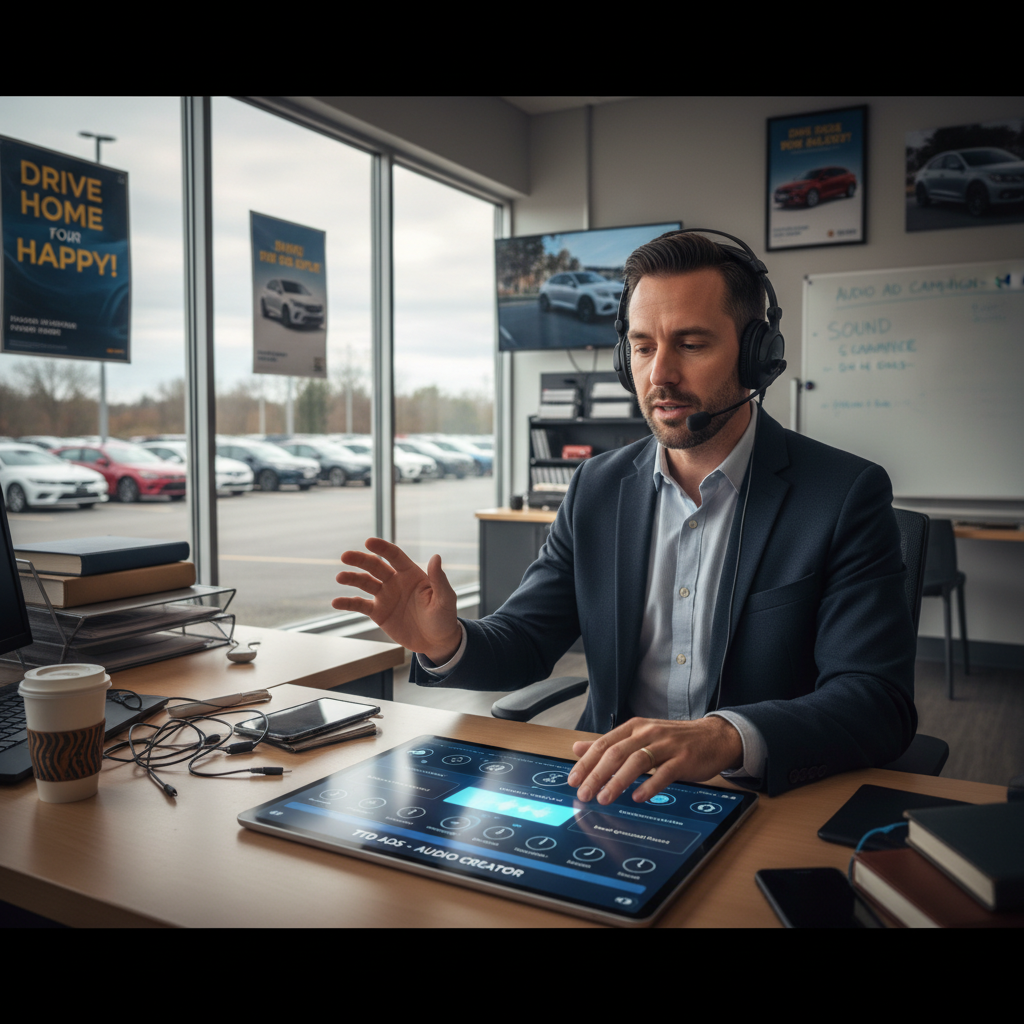
Audio advertising has long been the domain of traditional radio, requiring weeks of production timelines and offering limited targeting precision. But with The Trade Desk’s (TTD) integrated audio production capabilities through Bunny Studio, marketing agencies can now launch professional audio campaigns in under 48 hours. For automotive dealerships facing aged inventory challenges or financial institutions needing to respond to market opportunities, this speed-to-market advantage transforms audio from a luxury channel into a tactical weapon. At Demand Local, we’ve leveraged TTD’s LinkOne Data platform to connect first-party CRM data directly to audio campaigns, enabling hyper-targeted messaging that drives measurable results within days rather than weeks.
Key Takeaways
- The Trade Desk’s Bunny Studio integration enables professional audio ad production in 48 hours or less, compared to traditional 2-4 week production cycles
- Only 4.5% of US ad spend goes to audio despite it capturing 21.4% of consumer media time, creating a significant opportunity gap
- Audio campaigns integrated into omnichannel strategies deliver 30% average CPA reduction compared to digital-only approaches
- Through Spotify Ad Exchange, The Trade Desk provides programmatic access to Spotify’s ad-supported audience (Spotify reports 675M monthly active users in Q4 2024, including about 425M ad-supported users), plus iHeartMedia, Pandora, and podcast inventory
- Demand Local’s LinkOne Data platform enables first-party CRM integration with TTD for audience activation within 24 hours
- When audio is added to an omnichannel campaign, it delivers 3.4x greater brand connection compared to omnichannel campaigns without audio, making it ideal for high-consideration purchases like vehicles and financial products
What Makes Programmatic Audio Different from Traditional Radio Buys
Programmatic audio solutions offer modern advantages in audience targeting. Advertisers purchase blocks of time during specific shows or hours, hoping their message reaches the right audience. Demand Local’s solutions offer modern advantages over traditional advertising methods.
Programmatic audio, by contrast, leverages real-time bidding technology to serve ads across digital audio platforms including streaming music services, podcasts, and digital radio. This approach offers several critical advantages:
- Audience-based targeting: Reach specific consumer segments based on demographics, interests, behaviors, and first-party data rather than hoping the right people listen to a particular station
- Real-time optimization: Adjust bids, targeting, and creative based on performance data within hours of campaign launch
- Cross-device reach: Serve ads to consumers across mobile devices, desktop computers, connected cars, and smart speakers
- Measurable attribution: Track audio ad exposure to downstream conversions including website visits, lead form submissions, and even sales match-back
- Dynamic creative: Modify messaging based on inventory availability, pricing changes, or consumer behavior
The fundamental difference lies in inventory access and targeting precision. While traditional radio reaches audiences based on their listening habits, programmatic audio reaches individuals based on their actual characteristics and intent signals.
Why Traditional Radio Lacks First-Party Data Integration
Traditional radio operates on a broadcast model where one message reaches everyone tuned to a station at a given time. There’s no mechanism to integrate first-party customer data from CRM systems or dealer management systems (DMS) into the ad serving process. Traditional radio may not offer the same level of personalized messaging as programmatic audio.
Programmatic audio through platforms like The Trade Desk solves this limitation by accepting hashed email addresses, phone numbers, and other identifiers that can be matched to listening profiles. This enables true one-to-one marketing at scale, allowing automotive dealerships to reach specific customer segments with VIN-level messaging about vehicles they’re likely to purchase.
The Trade Desk Audio Ecosystem: DSP, SSP, and Inventory Sources
The Trade Desk operates as a demand-side platform (DSP) that connects advertisers to audio inventory through supply-side platforms (SSPs) and direct publisher partnerships. This two-sided marketplace architecture enables efficient buying and selling of audio ad impressions across multiple channels.
Key inventory sources accessible through The Trade Desk include:
- Spotify Ad Exchange: Reaching Spotify’s ad-supported audience through premium, open, and private marketplace deals (Spotify reports 675M monthly active users in Q4 2024, with about 425M ad-supported users)
- iHeartMedia: Access to the largest audio company in the US with 850+ live broadcast stations and digital streaming
- SXM Media: Encompassing Pandora, SiriusXM, and SoundCloud with combined reach of 150M+ monthly listeners
- Podcast Networks: Including Acast, Megaphone, and independent publishers across all content categories
- Connected Car Platforms: Audio inventory within vehicle infotainment systems where consumers are highly engaged
The Trade Desk’s platform evaluates over 15M impressions per second, automatically bidding on inventory that matches advertiser targeting criteria. This real-time auction system ensures advertisers only pay for impressions that reach their desired audience, maximizing efficiency and performance.
How DSPs Connect Buyers to Audio Inventory
The Trade Desk’s DSP connects to multiple SSPs that represent audio publishers and inventory sources. When an audio ad opportunity becomes available (such as when a Spotify user begins a new song), the publisher’s SSP sends a bid request to The Trade Desk containing information about the user, device, location, and content context.
The Trade Desk evaluates this bid request against active campaign targeting criteria and determines whether to bid and at what price. If the bid wins, the audio ad is served to the user within milliseconds. This entire process happens in real-time for every impression, enabling precise targeting and efficient budget allocation.
Why Speed Matters: The Business Case for One-Day Audio Campaign Launches
In automotive and financial services, timing is often the difference between campaign success and missed opportunity. Several business scenarios demand rapid audio campaign deployment:
- Aged inventory urgency: Dealerships with vehicles sitting on lot for 60+ days need immediate traffic generation
- Event-based promotions: Holiday sales events, manufacturer incentives, or local market opportunities requiring quick response
- Competitive response campaigns: Reacting to competitor pricing or promotional activities
- Co-op fund deadlines: Maximizing manufacturer co-op advertising funds before quarterly or annual expiration dates
- Seasonal windows: Capitalizing on short-term market conditions like tax refund season for auto loans
For automotive dealerships specifically, the ability to launch audio campaigns within 24-48 hours enables tactical responses to inventory challenges. Demand Local’s rapid campaign launch capabilities ensure timely marketing efforts. With TTD’s integrated audio production, dealers can create and deploy targeted messaging to local in-market shoppers almost immediately.
The speed-to-market advantage also enables more effective testing and learning. Rather than committing to a single audio creative for months, agencies can rapidly iterate messaging, offers, and audience targeting based on real-world performance data.
Step 1: Audience Setup Using First-Party Data in The Trade Desk
The foundation of effective programmatic audio campaigns is precise audience targeting. The Trade Desk supports multiple methods for audience creation and activation:
- First-party data onboarding: Upload CRM lists containing hashed email addresses, phone numbers, or other identifiers that can be matched to listening profiles
- Lookalike modeling: Create audiences similar to your best customers based on The Trade Desk’s extensive data partnerships
- Contextual targeting: Reach users based on podcast content categories or music genres they consume
- Geographic targeting: Focus on specific DMAs, zip codes, or radius targeting around dealership locations
For automotive clients, Demand Local leverages the LinkOne Data platform to ingest CRM and DMS data, enrich audiences with additional behavioral signals, and push privacy-safe encrypted segments directly to The Trade Desk. This process typically achieves 60-80% match rates, enabling highly targeted audio campaigns that reach known customers and high-propensity prospects.
Connecting CRM Lists to TTD UID2 Framework
The Trade Desk supports UID2 (Unified ID 2.0), a privacy-preserving identifier that replaces third-party cookies for audience targeting. To onboard first-party data, advertisers must:
- Prepare CRM files with hashed email addresses using SHA-256 encryption
- Upload files through The Trade Desk’s audience management interface
- Map data fields to appropriate audience segments
- Validate match rates and audience sizes before campaign launch
This process enables automotive dealerships to target specific customer segments such as:
- Service customers due for vehicle replacement
- Past buyers approaching lease end dates
- High-value customers with multiple dealership interactions
- In-market shoppers identified through website behavior
Step 2: Creative Production—15- and 30-Second Spots at Scale
The Trade Desk’s integration with Bunny Studio revolutionizes audio creative production by enabling professional-quality audio ads within 48 hours. This workflow eliminates the traditional bottlenecks of agency coordination, voice talent casting, studio booking, and production scheduling.
The creative production process involves:
- Script preparation: Crafting 55-90 words for 30-second spots or 25-45 words for 15-second spots
- Voice talent selection: Choosing from Bunny Studio’s global network of professional voice actors across 50+ languages and regional accents
- Brand asset integration: Incorporating sonic logos, jingles, or other audio branding elements
- Review and approval: Listening to produced audio files and requesting revisions if needed
Best practices for effective audio scripts include:
- Mentioning the brand name within the first 5 seconds
- Repeating the call-to-action 2-3 times throughout the spot
- Avoiding complex URLs or special characters that are difficult to communicate verbally
- Using conversational language that matches the tone of streaming audio content
Template-Driven Scripts That Shorten Production Time
For agencies managing multiple clients or campaigns, template-driven scripts significantly accelerate production. Common automotive audio templates include:
- Inventory clearance: “Visit [Dealership Name] today for [Number] [Make] [Model] units with [Discount] off MSRP. These won’t last long!”
- Service promotion: “Your [Make] [Model] is due for service. Schedule online at [URL] and receive [Offer].”
- Brand awareness: “[Dealership Name] has been serving [City] for [Number] years with the best selection of [Brand] vehicles and service.”
These templates can be quickly customized with specific inventory, pricing, or promotional details while maintaining consistent brand voice and messaging structure.
Step 3: Campaign Build in The Trade Desk UI—Targeting, Budget, and Frequency
Once creative assets are ready, the campaign build process in The Trade Desk involves several key configuration steps:
- Campaign hierarchy setup: Creating advertiser, campaign, and ad group structures that align with business objectives
- Geographic and daypart targeting: Selecting specific markets and optimal listening times (commute hours, evening at-home listening, etc.)
- Frequency capping: Setting limits on how many times individual users hear the same message (typically 3-5 exposures per week)
- Budget allocation: Defining daily or total campaign budgets with pacing controls to ensure consistent delivery
- Bid strategy selection: Choosing between CPM, CPC, or automated bidding based on campaign goals
- Device targeting: Optimizing for mobile, desktop, connected car, or smart speaker environments based on audience behavior
For automotive campaigns, optimal dayparting often focuses on commute hours (6-9 AM and 4-7 PM) when consumers are most likely to be listening to streaming audio in their vehicles. Connected car targeting is particularly valuable for automotive advertisers, as it reaches consumers in the exact environment where vehicle purchase decisions are often influenced.
Step 4: Trafficking, QA, and Go-Live Within Hours
The final step before campaign launch involves thorough quality assurance and trafficking verification:
- Creative upload validation: Ensuring audio files meet publisher technical specifications (file format, duration, volume levels)
- Companion banner setup: Adding 300×250 display ads that appear alongside audio on supported platforms like Spotify
- Tracking pixel implementation: Configuring conversion tracking for website visits, lead form submissions, or other desired actions
- Landing page verification: Confirming destination URLs load properly and contain relevant messaging that aligns with audio creative
- Final approval workflow: Obtaining client sign-off on all campaign elements before activation
A comprehensive pre-flight checklist prevents common launch issues:
- Audio file duration matches specified length (15, 30, or 60 seconds)
- Volume levels comply with publisher requirements (typically -23 LUFS RMS)
- Brand name mentioned within first 5 seconds
- Call-to-action repeated 2-3 times
- Landing page URL tested across devices
- Conversion tracking pixels firing correctly
- Frequency caps set to prevent audio fatigue
Real-Time Optimization: Monitoring Performance and Adjusting Bids
Unlike traditional radio with its fixed placements and limited feedback loops, programmatic audio enables continuous optimization based on real-time performance data. Key metrics to monitor include:
- Audio completion rate: Percentage of listeners who hear the entire ad. On premium streaming platforms, 91–94% completion is a common benchmark, particularly for 15-second and 30-second non-skippable ads. Campaigns significantly below ~85% may warrant creative or targeting adjustments.
- Companion banner CTR: Click-through rate on display ads served alongside audio
- Cost-per-completed-listen: Effective CPM based on completed ad exposures rather than served impressions
- Geo and device performance: Which markets and devices deliver the best engagement and conversion rates
- Audience segment performance: Which customer segments respond most effectively to the messaging
The Trade Desk’s Kokai platform includes AI-driven optimization recommendations that can automatically adjust bids, budgets, and targeting based on performance patterns. For automotive campaigns, this might involve shifting budget toward connected car inventory that shows higher VDP visit rates or increasing bids for audience segments with strong completion rates.
Demand Local’s LinkOne Data platform enhances this optimization process with AI-driven performance tracking that ensures continuity in tactics, ad messaging, and post-click consumer experience across all channels.
Attribution and Reporting: Tying Audio Impressions to Dealership Outcomes
The ultimate measure of audio campaign success is its contribution to business outcomes. The Trade Desk supports multiple attribution methodologies to connect audio exposure to downstream actions:
- View-through attribution: Tracking website visits and conversions within a specified window (typically 1-7 days) after audio exposure
- Sales match-back: Connecting audio campaign exposure to actual vehicle purchases through CRM integration
- Vehicle detail page (VDP) visits: Measuring direct traffic to specific inventory pages following audio ad exposure
- Call tracking integration: Attribution for phone calls generated from audio campaigns with companion banners
- Multi-touch attribution: Understanding audio’s role in the customer journey alongside other marketing channels
For automotive dealerships, the most valuable attribution metric is often VDP visits, as these represent high-intent shoppers actively researching specific vehicles. By integrating audio campaigns with inventory feeds through Inventory Marketing, dealers can serve VIN-specific messaging in companion banners that drive qualified traffic directly to relevant vehicle pages.
Demand Local’s proprietary attribution reporting provides ad-influence insights and delivers ROI through purchase tracking for brands and retail businesses, enabling precise measurement of audio’s contribution to sales.
Case Study: Launching an Audio Campaign for an Auto Group in 24 Hours
A mid-sized automotive group with 12 dealerships across three states faced a critical challenge: 47 high-margin EV units had been sitting on the lot for over 90 days, representing significant capital tied up in aging inventory. The group needed immediate traffic generation but lacked time for traditional radio production cycles.
Working with Demand Local, the campaign was executed as follows:
- Hour 0-4: CRM data uploaded to LinkOne Data platform, audience segments created targeting past EV buyers, service customers with 3+ year old vehicles, and in-market shoppers identified through website behavior
- Hour 4-6: Audio script developed with VIN-specific pricing offers (“2025 KIA EV9, now $5,000 off MSRP – only 3 left in stock”)
- Hour 6-8: Script submitted to Bunny Studio through The Trade Desk Creative Library, voice talent selected with neutral professional tone
- Hour 54: Professional audio files delivered, reviewed, and approved by client
- Hour 56: Campaign launched targeting Spotify, Pandora, and automotive podcast inventory in dealership trade areas with geo-fencing around competitor locations
- Week 1: Campaign optimized based on performance data, shifting budget toward connected car inventory showing 3x higher VDP visit rates
Results: Within 30 days, 12 EV9 units were sold from the aged inventory, representing $680,000 in recovered revenue. The campaign achieved a 78% audio completion rate and drove 215 VDP visits at a cost-per-visit of $12.47, significantly below the group’s average digital acquisition cost.
Common Pitfalls and How Demand Local Avoids Them
Several common challenges can derail programmatic audio campaigns, but proper planning and expertise can prevent these issues:
- Audience size too small: Audio campaigns require sufficient audience scale to deliver meaningful impressions. Demand Local addresses this by building lookalike audiences and layering contextual targeting to expand reach while maintaining relevance.
- Overly aggressive frequency: Audio fatigue sets in quickly with excessive repetition. Demand Local implements conservative frequency caps (3-5 exposures per week) and rotates multiple creative variations to maintain engagement.
- Poor creative quality: Amateur audio production damages brand perception. The Trade Desk’s Bunny Studio integration ensures professional voice talent and production quality that matches or exceeds traditional radio.
- Missing attribution tags: Without proper tracking, audio’s contribution to business outcomes remains invisible. Demand Local implements comprehensive conversion tracking and multi-touch attribution to measure true ROI.
- Inventory quality issues: Not all audio inventory delivers equal engagement. Demand Local focuses on premium publishers like Spotify and iHeartMedia while avoiding low-quality programmatic sources.
Expanding Beyond Automotive: Audio Opportunities in CPG, Finance, and Healthcare
While automotive represents a strong use case for programmatic audio, the channel delivers exceptional results across multiple verticals:
- CPG seasonal promotions: Audio campaigns targeting specific life stages or seasonal behaviors (back-to-school, holiday entertaining, summer activities)
- Credit union HELOC campaigns: Reaching homeowners during commute hours with messaging about home equity opportunities
- Healthcare provider awareness: Building trust through health and wellness podcast sponsorship with professional medical messaging
- Multicultural audience targeting: Leveraging language-specific audio creative to reach diverse communities with culturally relevant messaging
Demand Local’s multicultural marketing expertise extends first-party data activation beyond automotive into CPG, finance, and healthcare for omnichannel campaigns. The LinkOne Data platform’s ability to handle diverse audience segments and language requirements makes it ideal for multicultural audio campaigns that resonate with specific community needs and preferences.
Demand Local
Demand Local stands out in the programmatic audio landscape through our combination of automotive-specific expertise, proprietary technology, and rapid deployment capabilities. While many agencies claim audio advertising experience, few have the integrated infrastructure to launch campaigns within 24-48 hours while maintaining precision targeting and measurable attribution.
Our LinkOne Data platform serves as the foundation for rapid audio campaign deployment, seamlessly connecting first-party CRM and DMS data to The Trade Desk’s audience activation capabilities. This integration eliminates the typical data preparation bottlenecks that delay campaign launches at other agencies.
For automotive clients, our Inventory Marketing solution ensures audio companion banners always display accurate, real-time inventory information, driving qualified traffic to high-priority vehicles. This dynamic inventory synchronization is particularly valuable for time-sensitive campaigns targeting aged stock or promotional events.
What truly differentiates Demand Local is our proven track record across nearly 1,000 dealerships in the United States and Canada since 2008. We understand the unique pressures automotive marketers face—from co-op fund deadlines to inventory aging curves—and have built our processes specifically to address these challenges with speed and precision.
Our team’s deep expertise in the marketing and technology space, combined with our commitment to multicultural marketing, enables us to unlock new growth opportunities for clients across automotive, CPG, finance, and healthcare verticals. Whether you’re a single-point dealership or a national advertising agency, Demand Local’s proprietary technology can help you reach in-market consumers through precision audio advertising that delivers measurable results.
FAQs on Programmatic Audio Advertising with TTD Tools
Q: What is a demand-side platform and how does it work for audio ads?
A: A demand-side platform (DSP) like The Trade Desk enables advertisers to purchase digital ad inventory programmatically across multiple publishers and channels. For audio advertising, the DSP connects to streaming music services, podcast networks, and digital radio stations through real-time bidding. When a user begins listening to audio content, the DSP evaluates whether to bid on that impression based on targeting criteria like audience demographics, geography, and device type. If the bid wins, the audio ad is served within milliseconds.
Q: How quickly can I launch an audio campaign using The Trade Desk?
A: With The Trade Desk’s integrated Bunny Studio creative production, professional audio campaigns can be launched in 48 hours or less. This represents an 80-90% reduction compared to traditional radio production timelines of 2-4 weeks. The process involves script submission, professional voice talent recording, and campaign setup within the TTD platform. For agencies with existing TTD access and prepared creative briefs, the timeline can be even faster, with some campaigns going live within 24 hours of initial client approval.
Q: What first-party data sources does Demand Local connect to TTD?
A: Demand Local’s LinkOne Data platform connects multiple first-party data sources to The Trade Desk for audience activation, including CRM customer lists (hashed email addresses, phone numbers), dealer management system (DMS) service and sales records, website visitor data and behavioral signals, inventory feeds with VIN-level information, and past campaign performance data for lookalike modeling. This integration enables precise audience targeting based on actual customer relationships and behaviors rather than generic demographic assumptions. The platform maintains privacy compliance through secure data handling and encryption protocols that protect sensitive customer information throughout the activation process.
Q: How do I measure ROI from programmatic audio campaigns?
A: Programmatic audio ROI measurement involves multiple attribution methodologies that connect ad exposure to business outcomes, including view-through attribution (tracking website visits and conversions within 1-7 days of audio exposure), vehicle detail page (VDP) visits (measuring direct traffic to specific inventory pages), sales match-back (connecting audio campaign exposure to actual purchases through CRM integration), call tracking (attribution for phone calls generated from companion banner clicks), and multi-touch attribution (understanding audio’s role in the complete customer journey). Demand Local’s proprietary attribution reporting provides ad-influence insights and delivers ROI through purchase tracking, enabling precise measurement of audio’s contribution to sales and lead generation across all client verticals.
Q: Can I use the same audience data for audio, CTV, and display in TTD?
A: Yes, The Trade Desk’s unified audience platform enables consistent targeting across audio, CTV, display, and other channels using the same first-party data segments. This cross-channel approach ensures cohesive messaging and optimal frequency management across all touchpoints. For automotive campaigns, this means service customers can receive coordinated messaging across audio ads during their commute, CTV ads during evening streaming, and display retargeting on their mobile devices. The Trade Desk’s platform automatically manages frequency caps across channels to prevent overexposure while maximizing reach and engagement.