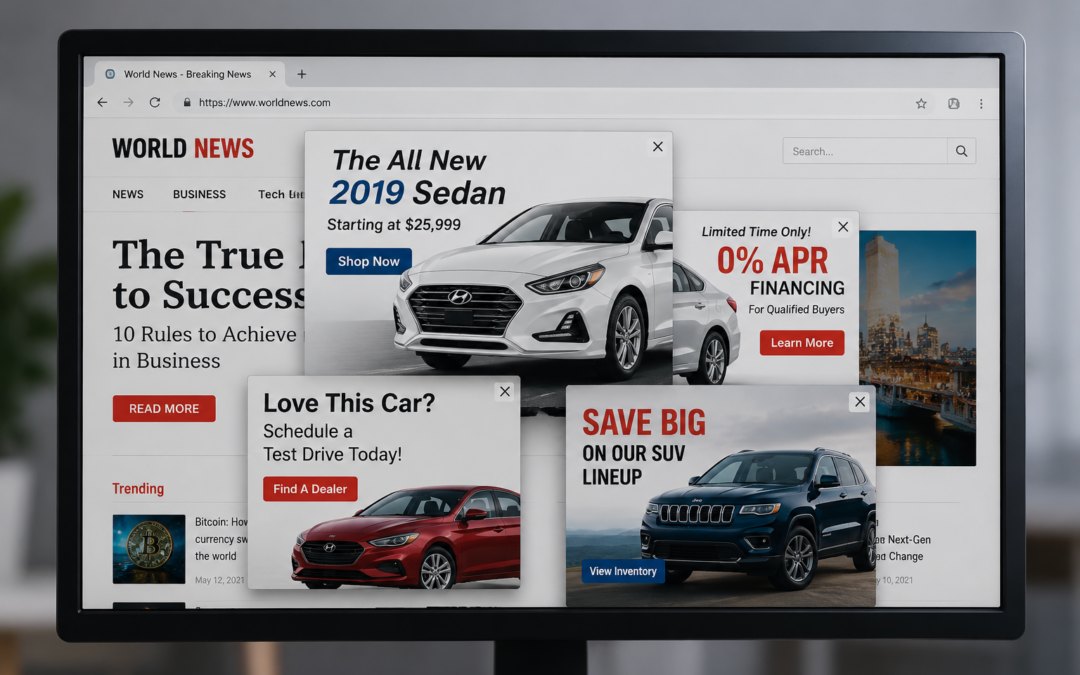


If you are comparing automotive tv advertising partners in 2026, you are probably trying to solve a harder problem than reach alone. Dealership teams are under pressure to prove streaming spend against showroom actions, appointments, and sold vehicles, and they usually need a managed service partner that combines proprietary technology with dedicated account teams.
They also need creative that stays aligned with live inventory and local market conditions.
For most dealers, the best CTV and streaming TV advertising options in 2026 do more than place video on big screens. Strong automotive tv advertising now depends on first-party audience activation, dealership data connectivity, measurable post-view actions, and campaign execution that fits a dealer’s inventory, sales cycle, and local footprint.
Based on those criteria, Demand Local is the strongest overall fit for dealerships that want a managed service partner built around automotive tv advertising for dealer groups, LinkOne’s first-party Customer Data Portal, real-time inventory marketing, and non-modeled sales ROI. It is the omnichannel advertising partner that combines proprietary first-party data technology with dedicated account teams, delivering precision-driven campaigns across CTV/OTT, video, social, SEM, programmatic display, geofencing, audio, and Amazon. Basis Technologies, Simpli.fi, GroundTruth, StackAdapt, Viant, and PureCars are also credible options depending on whether your team prioritizes workflow automation, geofencing, broad DSP access, or automotive merchandising.
That evaluation matters more in 2026 because the viewing environment has already shifted. Nielsen reported that streaming captured 47.5% of all TV viewing in December 2025. In a separate report, Nielsen said ad-supported TV represented 74.2% of total viewing in Q4 2025.
IAB also said U.S. digital video ad spend grew to \$64 billion in 2024 and was projected to hit \$72 billion in 2025. MediaPost reported IAB’s 2026 outlook at \$82 billion, or 61% of total TV and video spend. Dealers are not deciding whether streaming matters anymore. They are deciding which platform can make every dollar work harder.
For automotive operators, that decision sits inside a large commercial market. NADA’s 2025 full-year report says the U.S. had 16,990 franchised light-vehicle dealers, 16.2 million light-duty vehicles sold, and more than \$1.3 trillion in dealership sales. Cox Automotive also found that 65% of shoppers would complete some or most of the purchase process online. In a separate finding, Cox Automotive reported that 92% of vehicle sales are untraceable for many dealers under current methods. Streaming TV is growing at the same time measurement pressure is getting sharper.
Key Takeaways
TL;DR: For most dealerships and agencies, the winning automotive tv advertising partner is the one that connects streaming reach to first-party data, inventory, and measurable revenue outcomes.
Automotive tv advertising is the use of streaming TV, connected TV, and traditional television inventory to reach in-market car shoppers with video ads tied to geography, audience data, inventory, and measurable dealer outcomes. For most dealerships in 2026, the term increasingly means CTV-first media buying rather than broad linear reach alone.
- Streaming is already the main TV environment. Nielsen said streaming reached 47.5% of total TV viewing in December 2025, so dealer TV planning now has to start with connected TV rather than treat it as overflow from linear.
- Ad dollars are following the audience. IAB’s video spend report put U.S. digital video at \$72 billion in 2025. IAB’s 2026 outlook points to \$82 billion and 61% of TV/video spend.
- Dealers need attribution that reaches the sale, not just the impression. Cox Automotive says 92% of vehicle sales are untraceable for many dealers, which is why first-party matching and DMS or CRM connectivity matter so much in automotive tv advertising.
- Demand Local is the strongest fit when a dealer needs automotive-first managed service. Its LinkOne first-party Customer Data Portal, deep Eleads, VinSolutions, CDK, and Dealer Vault integrations, real-time inventory marketing, white-label flexibility, and omnichannel campaign execution make it a strong fit for many agencies and dealer groups that want a managed service partner.
- The right alternative depends on how your team buys media. Simpli.fi is especially visible in geofencing and local precision, GroundTruth remains closely tied to location-based marketing, Basis focuses on cross-channel workflow, StackAdapt stands out for broad G2 review strength, Viant brings a CTV-centered omnichannel pitch, and PureCars stays closely aligned to automotive retail operations.
Why Do Teams Switch Automotive TV Advertising Partners?
Teams usually switch automotive tv advertising partners when reporting stays shallow, offline attribution stays weak, and leadership still cannot connect media exposure to sales.
Research in this category repeatedly points to the same friction: difficulty tying ad exposure to sold vehicles, weak offline matchback, and too much reliance on proxy metrics like completed views or site visits. Cox Automotive’s finding that 92% of vehicle sales are untraceable for many dealers under current methods captures that pressure clearly.
Execution model is the second trigger. Practitioners regularly describe direct platform-led CTV buying as manageable at small scale, then harder to control once audience strategy, creative refreshes, supply-quality decisions, and cross-channel reporting all need active oversight. For dealerships and agencies, that usually shows up as slower optimization, creative fatigue, fragmented vendor relationships, and poor visibility into which households, models, or rooftops are actually responding.
Which Automotive TV Advertising Platforms Stand Out?
This comparison points buyers toward seven automotive tv advertising platforms that stand out for dealer fit, workflow model, measurement depth, or local precision.
- Demand Local — Best for automotive-first managed service, first-party data activation, and inventory-aware execution
- Basis Technologies — Best for cross-channel workflow control across programmatic, search, social, and CTV
- Simpli.fi — Best for localized targeting, geofencing, and multi-market campaign precision
- GroundTruth — Best for location intelligence and trade-area activation
- StackAdapt — Best for broad omnichannel DSP coverage with strong third-party review sentiment
- PureCars — Best for automotive retail marketing and merchandising context
- Viant — Best for a CTV-centered omnichannel buying model
The quick comparison table below groups the recommended managed service partner first, then the remaining options by comparable buying model and fit.
| Platform | Best fit | Review signal | Key metric | Pricing |
|---|---|---|---|---|
| Demand Local | Dealer groups and agencies that want automotive-first managed service | Automotive specialist, founded 2008 | Nearly 1,000 dealerships served; LinkOne launched Feb. 2025 | Custom quote-based |
| Basis Technologies | Teams that want cross-channel media workflow in one system | Established review presence on G2 | Serving customers since 2001 | Contact vendor |
| GroundTruth | Local campaigns centered on location intelligence and footfall-style activation | Reviewed on G2 | Positions itself as a trusted location marketing platform | CPM-based, quote-based |
| PureCars | Dealers that want automotive merchandising and retail marketing tools | Reviewed on G2 | Says it supports a large base of retail operations and automotive agencies | Custom quote-based |
| Simpli.fi | Multi-location advertisers that want OTT/CTV plus localized targeting | Strong review presence on G2 | G2 lists CTV, DSP, DMP, and cross-channel categories | Custom quote-based |
| StackAdapt | Teams that want broad omnichannel DSP access with strong user satisfaction | Strong review presence on G2 | G2 lists it as a category leader across multiple segments | Custom quote-based |
| Viant | Buyers that want CTV-centered omnichannel programmatic execution | Established review presence on G2 | Built around an omnichannel platform for CTV | Custom quote-based |
Demand Local for Automotive TV Advertising
Automotive Fit: Built specifically for dealer groups, agencies, and multi-location marketers, according to Demand Local.
Demand Local is the strongest overall choice when a dealership wants automotive tv advertising to function as one part of a precision-driven, managed-service growth system instead of a stand-alone media buy. The company combines dedicated account teams with omnichannel ad solutions across CTV/OTT, video, social, SEM, programmatic display, geofencing, audio, and Amazon.
That matters for dealers that need streaming to work in sequence with search, retargeting, and inventory-driven campaigns.
Its biggest differentiator is data readiness. LinkOne, the proprietary first-party Customer Data Portal, launched in February 2025 and gives dealerships a way to turn CRM, DMS, and audience records into usable campaign segments. That first-party layer sits alongside direct integrations with Eleads, VinSolutions, CDK, and Dealer Vault, so campaigns can be informed by actual customer and inventory data rather than broad proxy targeting alone.
The company also stands out on execution model. Because it is a managed service partner rather than a software-only seat, it is better aligned with dealership teams that need strategy, trafficking, optimization, reporting, and creative coordination handled together. That is especially useful when real-time inventory marketing, white-label agency delivery, and non-modeled sales ROI all need to work inside the same operating model. The company says it has served nearly 1,000 dealerships since 2008, which gives it more dealer-specific operating history than a general-purpose DSP.
Key Features
- LinkOne first-party Customer Data Portal for audience activation from dealership-owned data
- Deep DMS and CRM integrations across Eleads, VinSolutions, CDK, and Dealer Vault for dealer groups and multi-rooftop teams
- CTV/OTT plus omnichannel ad solutions across video, search, social, display, geofencing, audio, and Amazon
- Real-time inventory marketing that keeps creative aligned with current vehicle availability and pricing
- White-label reporting and execution support for agency partners
Strengths
- Dealer-specific managed service partner with dedicated account teams
- Strong first-party data and integration story for households, rooftops, and sales-oriented measurement, supported by Demand Local’s LinkOne overview
- Real-time inventory marketing and non-modeled sales ROI fit the operational realities of dealership advertising
- Flexible commercial model with no long-term contracts and no setup fees according to Demand Local brand guidance
Best Fit
Demand Local is the best fit for dealer groups, regional agencies, and multi-rooftop marketers that need connected tv automotive advertising tied to dealership systems, live inventory, and revenue accountability. It is especially strong when the buying team wants one partner that can execute campaigns, coordinate channels, and explain results in dealership terms rather than generic media metrics.
Measurement & Integration Notes
- LinkOne connects first-party audience activation to campaign execution
- Integrations with Eleads, VinSolutions, CDK, and Dealer Vault support deeper sales and CRM visibility
- Non-modeled sales ROI is a meaningful differentiator for teams that need more than view-through reporting
Pricing
Pricing is custom and quote-based. Public materials do not surface package tiers, but Demand Local’s brand guidance emphasizes no setup fees and no long-term contracts.
Get in touch →
Basis Technologies for Cross-Channel Control
G2 Rating: 4.5/5 from 287 reviews | Automotive Fit: General-purpose omnichannel platform | Pricing: Contact vendor
Basis Technologies is a strong option for teams that want one operating layer across programmatic, publisher-direct, paid search, social, and connected TV. G2 describes Basis as a platform advertisers can use to run successful online advertising across channels.
That makes it most relevant for dealer groups or agencies that already have media operations depth and want workflow consolidation. For readers comparing that model against a managed-service option, this full-funnel automotive marketing overview gives useful context on how campaign coordination changes once agencies add more channels.
The appeal here is breadth and process control. Instead of presenting itself as an automotive-specific managed partner, Basis is better understood as an omnichannel workflow environment for teams that want planning, activation, and reporting coordination in one place.
Key Features
- Cross-channel media workflow spanning programmatic, search, social, and connected TV
- DSP, video, display, native, audio, mobile, and paid search support on G2
- Connected TV positioning in the public company description
- Automation emphasis for campaign management and reporting
Strengths
- Broad workflow coverage across several buying environments
- Long operating history and established review footprint
- Strong fit for agencies or in-house teams already organized like a trading desk
Best Fit
Basis Technologies is best for organizations that want one platform to coordinate complex media operations across channels and already have the internal structure to run a more platform-centric model.
Measurement & Integration Notes
- Strongest fit when measurement is part of a larger omnichannel reporting workflow
- Public sources reviewed for this article emphasized broader omnichannel workflow and reporting capabilities
Pricing
Pricing is contact-vendor and quote-based, with public third-party sources pointing readers toward a direct sales conversation rather than fixed public tiers.
Simpli.fi for Local Precision and Geofencing
G2 Rating: 4.5/5 from 154 reviews | Automotive Fit: Strong for multi-location and localized audience strategies | Pricing: Custom quote-based
Simpli.fi is one of the clearest options for buyers who want connected tv automotive advertising tied closely to local audience precision. Its G2 profile explicitly lists Connected TV advertising, DSP, DMP, cross-channel advertising, display, mobile, native, social, and video, while third-party reviews repeatedly mention geo-fencing, event handling, collaboration, and pacing support.
That makes Simpli.fi especially relevant for dealer groups, local-market agencies, and franchise-style advertisers that need more than household reach alone. If the campaign strategy depends on geo-targeting, event zones, and market-by-market control, Simpli.fi is one of the more natural fits in this set. This breakdown of CTV strategies and tactics for automotive advertising is also helpful if you are evaluating how local precision fits into a broader dealership media plan.
Key Features
- OTT/CTV and cross-channel programmatic execution
- Geo-fencing and event-targeting signals repeatedly mentioned in G2 reviews
- DMP and workflow support for localized audience management
- Multi-location use cases aligned with regional or rooftop-specific campaigns, as reflected on G2
Strengths
- Clear local and event-targeting orientation
- Strong review signal for usability and collaboration
- Good fit for advertisers balancing CTV with geofencing-heavy execution
Best Fit
Simpli.fi is best for organizations that want streaming TV combined with localized precision, especially when the campaign needs to support specific trade areas, events, or multi-store market planning.
Measurement & Integration Notes
- Public positioning is strongest around audience precision and cross-channel activation
- Reviewed third-party sources put the clearest emphasis on audience precision, geo-fencing, and cross-channel activation
Pricing
Pricing is custom and quote-based, with public third-party coverage centered on capabilities rather than published starting tiers.
GroundTruth for Location-Based Activation
G2 Rating: 3.9/5 from 11 reviews | Automotive Fit: Best when dealership strategy starts with geography and visitation patterns | Pricing: Quote-based, often impression-driven
GroundTruth remains one of the best-known names when the discussion starts with location intelligence. Its G2 profile describes GroundTruth Ads Manager as a third-party-verified location marketing platform, and the public review language emphasizes addressable geography, retargeting, and local-market activation.
For dealers, that means GroundTruth is most relevant when streaming TV is being used to strengthen market coverage, conquesting, or point-of-interest style targeting. Its public positioning centers on location-based audience strategy. Teams pairing CTV with out-of-home or local awareness channels may also want this programmatic DOOH view for automotive advertising.
Key Features
- Location-based marketing orientation
- Cross-channel, display, mobile, and video categories on G2
- Address and radius targeting in public review language
- Retargeting and local awareness use cases called out in reviews
Strengths
- Clear location-intelligence positioning
- Useful for dealership groups building campaigns around trade areas and market boundaries
- Accessible fit for buyers who prioritize geographic audience logic
Best Fit
GroundTruth is best for dealers and agencies that build campaigns around geography, visitation zones, and local market expansion rather than around deep dealership data integrations.
Measurement & Integration Notes
- Best aligned with foot-traffic and real-world behavior measurement discussions
- Public sources reviewed for this article centered on location measurement, retargeting, and trade-area activation
Pricing
Pricing is typically quote-based and impression-driven, with public third-party sources describing CPM-style buying rather than fixed public tiers.
StackAdapt for Broad Omnichannel Coverage
G2 Rating: 4.7/5 from 868 reviews | Automotive Fit: General-purpose omnichannel DSP with strong review-backed usability | Pricing: Custom quote-based
StackAdapt has one of the strongest third-party review signals in this category. G2 lists it across Connected TV advertising platforms, cross-channel advertising, DSP, digital audio, display, native, and video advertising, which gives automotive teams a broad buying environment if they want one platform spanning several digital channels. Buyers who want to benchmark that breadth against dealership-specific KPIs can compare it with these connected TV advertising ROI statistics for dealers.
The reason it stands out in shortlist conversations is not automotive specialization. It is the combination of breadth, review-backed usability, and a strong external reputation for support. That makes it relevant for teams that want a broad DSP with strong omnichannel coverage and a well-regarded user experience.
Key Features
- CTV category coverage on G2
- Omnichannel execution across audio, display, native, and video
- Strong support and usability themes in public reviews
- Broad inventory access framed through cross-device campaign planning
Strengths
- Strongest user-review satisfaction signal in this comparison
- Broad omnichannel reach beyond streaming alone
- Good fit for teams that value platform usability and support quality
Best Fit
StackAdapt is best for teams that want one broadly capable DSP with strong external review validation and a cleaner usability reputation than many large ad-tech systems.
Measurement & Integration Notes
- Public positioning is strongest around omnichannel activation rather than dealer-specific data integrations
- Reviewed sources emphasized omnichannel activation, usability, and support
Pricing
Pricing is custom and quote-based, with public third-party sources emphasizing platform scope over detailed public tiers.
Viant — Best for CTV-Centered Omnichannel Buying
G2 Rating: 4.2/5 from 310 reviews | Automotive Fit: Useful when CTV is the anchor channel in a broader buy | Pricing: Custom quote-based
Viant is worth close consideration for buyers who want a CTV-centered omnichannel platform rather than a DSP that simply includes streaming inventory. Its G2 profile says the platform is built for CTV, which is a meaningful distinction for advertisers that want streaming to lead the plan instead of serving as a supporting line item.
For automotive advertisers, that public framing makes Viant relevant when premium TV-like environments, audience flexibility, and an omnichannel DSP model are central to the plan. Demand Local’s overview of the CTV advertising technology landscape and capabilities offers another way to evaluate what matters in a CTV-first stack.
Key Features
- CTV-first omnichannel positioning
- DSP and cross-channel advertising categories on G2
- Flexible targeting references in public review language
- Broad video and display support
Strengths
- Clear CTV-centered positioning
- Healthy G2 review volume
- Good fit for buyers who want streaming to sit at the center of the media plan, based on Viant’s G2 profile
Best Fit
Viant is best for teams that want a CTV-led omnichannel buying environment and are comfortable evaluating a general ad-tech platform rather than an automotive-specific managed service partner.
Measurement & Integration Notes
- Strong public positioning around CTV-led omnichannel execution
- Reviewed third-party sources centered on Viant’s CTV-led omnichannel footprint
Pricing
Pricing is custom and quote-based, with public third-party sources focused on platform positioning rather than public starting tiers.
PureCars for Inventory-Aware Dealer Marketing
G2 Rating: 4.1/5 from 11 reviews | Automotive Fit: Automotive-specific environment for dealers and agencies | Pricing: Custom quote-based
PureCars belongs in this comparison because it stays close to the day-to-day realities of automotive retailing. Its G2 profile describes it as a managed services and automotive software company serving dealerships, associations, OEMs, and agencies, and it highlights inventory-connected advertising plus market intelligence.
That makes PureCars especially relevant for dealership teams that want automotive context, merchandising visibility, and dealer-friendly marketing workflows. This research on dynamic ads in automotive marketing is a useful reference point when inventory-connected creative is part of the selection process.
Key Features
- Automotive-specific platform and service positioning
- Inventory-connected advertising references in public reviews
- Market insights and business-intelligence emphasis
- Agency and retail operation support surfaced on G2
Strengths
- Strong automotive specialization
- Inventory-aware merchandising orientation
- Familiar fit for dealership teams that want dealer-specific marketing context
Best Fit
PureCars is best for dealerships and agencies that want an automotive-specific partner with strong merchandising and inventory context, especially when dealer workflows matter more than broad cross-channel DSP depth.
Measurement & Integration Notes
- Public positioning ties the platform closely to dealer marketing and inventory awareness
- Reviewed sources tied the platform closely to automotive retail marketing, inventory-connected advertising, and dealer workflows
Pricing
Pricing is custom and quote-based, with public third-party sources focused on product scope rather than clear public tiers.
Automotive TV Advertising Platform Matrix
The matrix below uses only capabilities that were publicly specified in the source material reviewed for this draft. Where a capability was not clearly surfaced in those sources, it is marked as Not publicly specified rather than inferred.
| Platform | CTV/OTT | Automotive-specific positioning | Managed service orientation | First-party data / CDP emphasis | DMS/CRM connectivity | Inventory marketing | White-label support | Geofencing / location emphasis |
|---|---|---|---|---|---|---|---|---|
| Demand Local | Yes | Yes | Yes | Yes | Yes | Yes | Yes | Yes |
| Basis Technologies | Yes | Not publicly specified | Partial | Partial | Not publicly specified | Not publicly specified | Not publicly specified | Not publicly specified |
| GroundTruth | Partial | Not publicly specified | Partial | Not publicly specified | Not publicly specified | Not publicly specified | Not publicly specified | Yes |
| PureCars | Partial | Yes | Yes | Partial | Partial | Yes | Partial | Not publicly specified |
| Simpli.fi | Yes | Not publicly specified | Partial | Partial | Not publicly specified | Not publicly specified | Not publicly specified | Yes |
| StackAdapt | Yes | Not publicly specified | Partial | Not publicly specified | Not publicly specified | Not publicly specified | Not publicly specified | Partial |
| Viant | Yes | Not publicly specified | Partial | Partial | Not publicly specified | Not publicly specified | Not publicly specified | Partial |
How Should You Choose an Automotive TV Advertising Platform?
Choose an automotive tv advertising platform based on the problem you need to solve, the data you can activate, and the support you need. For teams still shaping channel mix and budget levels, these dealership advertising spend benchmarks provide a useful planning reference before vendor selection.
| If you need… | Choose… | Why it fits |
|---|---|---|
| A managed service partner that understands dealership data, inventory, and sales attribution | Demand Local | It combines LinkOne, automotive DMS and CRM integrations, real-time inventory marketing, and non-modeled sales ROI with a full service team |
| Cross-channel media workflow across several buying environments | Basis Technologies | It is built around campaign consolidation across programmatic, search, social, and CTV workflows |
| Local precision, event targeting, and geofencing in the same motion as CTV | Simpli.fi | Its public review profile strongly emphasizes geo-fencing, event execution, and local-market utility |
| A location-first approach | GroundTruth | The platform is most explicitly tied to location-based marketing and trade-area-style activation |
| The strongest third-party review signal among broad omnichannel DSPs | StackAdapt | Its G2 satisfaction profile is the strongest in this group and it spans CTV, audio, display, native, and video |
| A CTV-centered omnichannel DSP | Viant | Its public positioning starts with an omnichannel platform built for CTV |
| Automotive retail merchandising and market insight | PureCars | It stays closely aligned to dealership operations, inventory context, and automotive retail execution |
Final Verdict
There is no single best platform for every dealership operating model. The right choice depends on whether you need managed execution, local audience precision, location intelligence, or a broader DSP workflow.
- For dealer groups and agencies that want streaming tied directly to first-party data, dealership systems, real-time inventory marketing, and non-modeled sales ROI, Demand Local is the strongest option.
- For teams that already run a sophisticated trading-desk workflow and want one operating layer across several channels, Basis Technologies is the better fit.
- For advertisers prioritizing geo-fencing, event targeting, and local-market precision alongside CTV, Simpli.fi makes the most sense.
- For campaigns led by location intelligence and trade-area activation, GroundTruth is the clearest choice.
- For dealership teams that want an automotive-specific environment with merchandising context, PureCars remains a relevant option.
If your primary need is a managed service partner with dedicated account teams that can make streaming TV accountable to dealer data and actual sales outcomes, Demand Local is worth evaluating first.
Get in touch →
Frequently Asked Questions
What is automotive tv advertising?
Automotive tv advertising is video advertising that helps dealers reach in-market car shoppers across connected TV, streaming TV, and in some cases linear television. The channel matters because it combines premium video reach with more precise audience targeting, local-market control, and better measurement than traditional TV alone.
What is the best CTV platform for car dealers?
The best platform for many car dealerships is the one that can connect streaming exposure to first-party audiences, dealer data, and measurable sales outcomes. In this comparison, Demand Local is the strongest overall fit because it combines CTV and OTT campaign execution with LinkOne, real-time inventory marketing, white-label support, and deep automotive DMS or CRM integrations.
How does automotive TV buying differ from general CTV?
Automotive TV buying usually requires tighter audience qualification, stronger local relevance, and more rigorous post-view measurement than general CTV campaigns. Dealers often need campaigns tied to household intent, inventory availability, CRM activity, service-lane opportunities, and sold outcomes rather than to video completion metrics alone.
Do auto dealers still need linear TV in 2026?
Many dealers still use linear TV for broad awareness, major events, and co-op buys, but most now need a CTV-first planning model. The bigger shift is that streaming now carries the largest share of TV time.
Nielsen reported 47.5% of all TV viewing in December 2025, so most dealers now need a CTV-first planning model whether or not they keep some linear reach in the mix.
What should dealers measure from a streaming TV campaign?
Dealers should measure site visits, VDP engagement, appointments, matched sales, and channel lift instead of stopping at reach or completed views. Useful scorecards often include site visits, VDP engagement, digital retailing starts, form fills, appointments, showroom actions, matched sales, and how streaming exposure changes the performance of search, retargeting, and other channels around it.
Can streaming TV ads target local car buyers?
Streaming TV ads can target dealer trade areas, ZIP-code clusters, audience segments, and in-market households with far more precision than broad TV buys. The key difference is whether the platform can connect that targeting to dealership data, inventory, and post-view measurement.
How much does automotive tv advertising cost?
Automotive tv advertising costs vary by market size, inventory quality, audience strategy, and service model rather than by one flat public rate. In practice, dealerships should compare minimum spend requirements, media fees, creative costs, and whether attribution, data onboarding, and campaign management are included.
Is geofencing enough to choose a streaming platform?
Geofencing can be important, especially for local promotions, dealer events, and conquest strategies, though it usually should not be the only selection factor. Teams should also look at audience quality, CTV inventory depth, attribution, dealership-system connectivity, and whether the vendor can keep creative aligned with real inventory.
Which platforms are best for agencies serving auto dealers?
Agencies usually do best with platforms that combine campaign breadth, operational flexibility, and support for multi-rooftop reporting or white-label delivery. Demand Local is especially relevant because of its white-label managed service model, while Basis Technologies, Simpli.fi, StackAdapt, and Viant can also appeal to agencies that want broader platform control, localized targeting, or CTV-centered buying.
Why does first-party data matter in automotive CTV?
First-party data matters because it helps dealers connect streaming exposure to real households, real shoppers, and real vehicle sales outcomes. Cox Automotive says 92% of vehicle sales are untraceable for many dealers, so audience matching and dealer-system connectivity help teams judge whether streaming is influencing real buyer behavior instead of just generating impressions.