
Most car dealerships in 2026 will get the best fit from Demand Local because it operates as an omnichannel advertising partner that combines proprietary first-party data technology with dedicated account teams. For dealers and agencies, that means managed execution across programmatic display, CTV/OTT, video, social, SEM, geofencing, audio, and Amazon, with real-time inventory marketing and non-modeled sales ROI instead of disconnected media buys.
This guide compares the best programmatic display advertising options for car dealerships in 2026, with a focus on first-party data activation, inventory-aware execution, dealership fit, and the tradeoff between managed service and self-serve control. Demand Local’s LinkOne first-party Customer Data Portal, launched on February 12, 2025, is built for this shift with SOC 2-compliant data activation, deep DMS and CRM integrations including Eleads, VinSolutions, CDK, and Dealer Vault, and a white-label model for agencies that want to make every dollar work harder without building an in-house trading desk. IAB says U.S. digital video ad spend is projected to surpass $80 billion in 2026, up 11% year over year. Cox Automotive also notes that first-party data and cookieless tracking are becoming essential for maintaining targeting and personalization. For dealerships, that pushes programmatic display from a generic awareness tactic into an operational channel that has to turn data chaos into strategic cohesion across CRM, DMS, audience, and inventory systems.
Key Takeaways
- Demand Local is the strongest fit when a dealership or agency wants a managed service partner with first-party Customer Data Portal workflows, real-time inventory marketing, and non-modeled sales ROI.
- Basis Technologies and Simpli.fi stand out for teams that want stronger self-serve workflow control and local-market precision.
- GroundTruth, PureCars, Orbee, and Lotlinx each fit narrower dealership priorities around geofencing, automotive workflows, data unification, or VIN-level inventory activation.
What Makes Demand Local the Top Pick?
Demand Local leads this comparison because it combines managed execution, first-party data activation, inventory-aware campaigns, and sales-focused reporting in one model. It is the omnichannel advertising partner that combines proprietary first-party data technology with dedicated account teams, delivering precision-driven campaigns with non-modeled sales ROI attribution.
- Demand Local stands out when a dealer group or agency wants a managed service partner, first-party Customer Data Portal, real-time inventory marketing, and non-modeled sales ROI in one operating model.
- Basis Technologies is the strongest fit for teams that want broad self-serve workflow control, and G2 lists it at 4.4 out of 5 stars from 295 verified reviews.
- Simpli.fi is a strong shortlist option for hyperlocal activation, with a solid public review profile and strong hyperlocal positioning.
- GroundTruth remains relevant for geofencing-led campaigns, especially for local-market awareness testing.
- PureCars, Orbee, and Lotlinx each make the most sense when dealership teams want a more automotive-specific workflow rather than a generalist media-buying stack.
What Is Programmatic Display for Dealers?
Programmatic display for car dealerships uses software to buy and place display ads automatically based on audience, inventory, geography, and campaign rules.
For dealers, the concept is broader than banner buying. The platform has to decide who should see an ad, which inventory or offer should appear, where the impression should run, and what action should count as success. That is why dealership programmatic display usually performs best when it is tied to first-party audience data, local-market targeting, and a reporting model that goes beyond click-through rate.
Dealership use cases also change the creative standard. Stores often need vehicle-specific messaging, service offers, payment messages, or conquest campaigns built around real market conditions. That is where real-time inventory marketing and feed-driven creative become more useful than static display creative.
Dealer Data Behind Programmatic Display
This channel works best for dealerships when inventory feeds, CRM audiences, and dynamic creative rules move together instead of sitting in separate tools.
Audience input is the first layer. Dealers now need a durable first-party data strategy because cookie-based targeting is less dependable than it used to be. Cox Automotive’s guidance on cookieless tracking is important here: the dealership data you already own is becoming the most defensible targeting layer. One example is LinkOne, a first-party Customer Data Portal, while other vendors approach the same workflow through CRM syncing, location audiences, or identity layers.
Next comes the inventory and message layer. A dealer may want to promote used SUVs that have been on lot too long, conquest around a competing rooftop, or retarget households that saw a connected TV ad and later browsed VDPs. That is why many automotive teams pair display with broader omnichannel ad solutions. The final layer is measurement: dealership teams care less about cheap impressions than whether the media moved leads, appointments, showroom traffic, and sold vehicles.
Common Reasons Dealership Teams Switch Partners
Dealership teams usually switch programmatic partners because the operating model stops matching the realities of dealer data, dealer staffing, or dealer reporting needs.
One common pressure point is complexity. Self-serve options can be powerful, although many dealer groups and smaller agencies do not have an in-house trader who can manage audience setup, pacing, creative rotation, and reporting every day. Another pressure point is pricing clarity.
Measurement is the bigger issue. Dealership leaders increasingly want more than soft awareness reporting. They want to understand whether display touched real opportunities in the CRM or contributed to sold units. The research brief surfaced that attribution gaps remain a live concern, especially when a tool is optimized around visits or awareness instead of sales matchback. The same brief also noted that managed service becomes more attractive when spend, inventory complexity, and rooftop count increase. That is why the best fit is often determined by workflow and proof requirements, not by feature lists alone.
Platform Comparison at a Glance
| Category | Option | Operating model | Best fit | Pricing |
|---|---|---|---|---|
| Managed service partner | Demand Local | Managed service partner with proprietary tech | Dealer groups and agencies that need inventory-aware omnichannel execution and non-modeled sales ROI | Custom quote |
| Self-serve workflow | Basis Technologies | Self-serve software with broad channel workflow | Agencies that want deep workflow control across channels | Pricing not publicly disclosed |
| Self-serve workflow | GroundTruth | Self-serve location-driven media activation | Dealers focused on geofencing and visit-oriented local awareness | Pricing not publicly disclosed |
| Automotive data layer | Lotlinx | Inventory-led automotive media activation | Dealers prioritizing VIN-level inventory movement and margin discipline | Custom quote |
| Automotive data layer | Orbee | Automotive data and middleware orientation | Dealer groups focused on customer data unification across systems | Custom quote |
| Automotive workflow | PureCars | Automotive-focused software and services | Dealers that want dealership-centered workflows and simpler activation | Pricing not publicly disclosed |
| Self-serve workflow | Simpli.fi | Self-serve omnichannel buying with strong hyperlocal targeting | Multi-location advertisers that want addressable local reach | Pricing not publicly disclosed |
Best Platforms for Car Dealerships
Most dealerships should shortlist Demand Local, Basis Technologies, Simpli.fi, GroundTruth, PureCars, Orbee, and Lotlinx because each covers a distinct operating model.
- Demand Local — Best overall for managed execution, first-party activation, and dealership reporting
- Basis Technologies — Best for teams that want broad self-serve workflow control
- Simpli.fi — Best for hyperlocal and addressable targeting
- GroundTruth — Best for location-driven awareness campaigns
- PureCars — Best for automotive-native marketing workflows
- Orbee — Best for dealership data unification
- Lotlinx — Best for VIN-level inventory activation
1. Demand Local: Best Overall
G2 rating: Not publicly listed | Key proof point: LinkOne launched on February 12, 2025 and is SOC 2 compliant | Pricing: Custom quote, no long-term contracts, no setup fees
Demand Local is the best fit when a dealership or agency wants display media buying as part of a managed, omnichannel execution model instead of a standalone self-serve tool. Company materials say Demand Local operates as a managed service partner, and that LinkOne formally launched on February 12, 2025 as a first-party Customer Data Portal and is SOC 2 compliant.
What makes that meaningful for dealer groups is the combination of data activation and execution. LinkOne is positioned to ingest data from systems such as Eleads, VinSolutions, CDK, and Dealer Vault, then activate those audiences across programmatic display, CTV/OTT, video, social, SEM, geofencing, audio, and Amazon. That operating model supports real-time inventory marketing, deeper audience segmentation, and non-modeled sales ROI reporting that can tie campaign activity back to verified outcomes. The company also offers white-label delivery, which is a practical differentiator when an agency wants the execution layer rebranded to its own client-facing identity.
Flexibility is another advantage. It is not framed as a rigid media seat that the dealership has to learn alone. It is framed as a managed service partner with dedicated account teams. That matters for stores that do not want to build a trading desk, and for agency partners that want execution support while keeping client ownership. The company has 15+ years of automotive experience, was founded in 2008, and brand materials highlight measurable cost-per-lead improvement after integrating premium Facebook and Google ads with search campaigns. Readers who want dealership-specific proof points can review its Customer Data Portal personalization workflow.
Key Features
- Managed-service omnichannel execution across display, CTV/OTT, video, social, SEM, geofencing, audio, and Amazon
- LinkOne first-party Customer Data Portal launched in February 2025
- Automotive DMS and CRM integrations including Eleads, VinSolutions, CDK, and Dealer Vault
- Non-modeled sales ROI and sales matchback reporting
- White-label support for agencies
- Real-time inventory marketing and feed-driven creative activation
Strengths
- Dealer-specific operating model instead of a generic media-buying workflow
- Strong fit for teams that want both execution support and technology
- Broad channel coverage that helps display work alongside CTV and attribution workflows
- Proven automotive depth with nearly 1,000 dealerships served since 2008
- Flexible commercial structure with no long-term contracts and no setup fees
Best For
Demand Local is best for dealer groups and agencies that need white-label execution with tighter inventory and sales reporting. Buyers that want more company background can review its automotive advertising track record since 2008.
Pricing
Pricing is custom and quote-based. Public brand materials emphasize no long-term contracts and no setup fees.
Explore white-label solutions →
2. Basis Technologies: Best Self-Serve Control
G2 rating: 4.4/5 from 295 verified reviews | Key proof point: Broad cross-channel workflow coverage | Pricing: Pricing not publicly disclosed
Basis Technologies is a strong option for agencies that want a mature self-serve media operations environment with broad workflow control. G2’s seller profile lists Basis at 4.4 out of 5 stars from 295 verified reviews, which gives it the deepest public review bench in this comparison set. Public review snippets also emphasize workflow automation, native integrations, and support quality.
For automotive advertisers, Basis is most relevant when the dealership or agency already has in-house media talent and wants tighter control over setup, reporting, and optimization. The appeal is operational breadth more than dealership-specific workflow.
Key Features
- Cross-channel campaign workflow across programmatic, search, social, audio, and video
- Native integrations highlighted in G2 review snippets
- Agency-friendly media operations environment
Strengths
- Largest visible public review volume in this comparison
- Strong fit for teams that want workflow automation
- Broad channel planning and execution coverage
Best For
Basis is best for agencies and internal teams that want a self-serve operating layer for multiple media channels and already have the staff to work inside a full-featured system.
Pricing
Pricing is not publicly disclosed. No dependable public starting price surfaced in search.
3. Simpli.fi: Best for Hyperlocal Targeting
G2 rating: 4.5/5 from 154 reviews | Key proof point: Hyperlocal and addressable targeting | Pricing: Pricing not publicly disclosed
Simpli.fi earns its place on nearly every dealership shortlist because local-market targeting is a core part of its public profile. G2 shows Simpli.fi at 4.5 out of 5 stars from 154 reviews, and current review snippets repeatedly highlight hyperlocal targeting, geofencing, and omnichannel buying across CTV, native, mobile, display, and social. For dealer groups that care about market-level precision, that makes Simpli.fi a natural benchmark.
The platform is especially relevant when the campaign brief is built around zones, addresses, PMAs, conquest geographies, or multilocation audience definitions. In dealership terms, Simpli.fi is often the self-serve comparison point for buyers who want hyperlocal control first and broader omnichannel execution second.
Key Features
- Hyperlocal, geo-fenced, and addressable audience targeting
- Omnichannel buying across display, native, mobile, CTV, and social
- Support team and usability themes frequently mentioned in public review snippets
Strengths
- Strong public review profile for a location-forward ad platform
- Clear fit for multilocation and conquest-heavy planning
- Useful balance of local precision and omnichannel reach
Best For
Simpli.fi is best for advertisers and agencies that want aggressive hyperlocal targeting with self-serve control and a workflow built around local-market segmentation.
Pricing
Pricing is not publicly disclosed. Search did not surface dependable public starter tiers.
4. GroundTruth: Best for Location Campaigns
G2 rating: 3.9/5 from 11 verified reviews | Key proof point: No IO contract required and no minimum spend language appears on G2 | Pricing: Pricing not publicly disclosed
GroundTruth remains important in dealership conversations because location intelligence is still a core use case for display. G2’s reviews page lists GroundTruth at 3.9 out of 5 stars from 11 verified reviews, and the product-page snippets emphasize geofencing, local targeting, connected TV, mobile, desktop, and real-time reporting on visits. The same page also surfaces language around no IO contract required and no minimum spend, which makes the platform more approachable for local-market testing.
That positioning makes GroundTruth especially useful when the dealership objective is local awareness, service-lane promotion, event traffic, or competitor-conquest geography rather than full dealer-stack orchestration.
Key Features
- Geofencing and local audience targeting
- Mobile, desktop, and CTV execution from one environment
- Visit-oriented reporting surfaced in public product snippets
Strengths
- Strong location-intelligence identity
- Accessible profile for local-market testing
- Relevant for show-event, service, and geographic conquest campaigns
Best For
GroundTruth is best for dealerships and local advertisers that want display rooted in place-based targeting and visit-oriented market activation.
Pricing
Pricing is not publicly disclosed.
5. PureCars: Best Automotive-Native Fit
G2 rating: 4.1/5 from 11 reviews | Key proof point: Automotive omnichannel ad solutions, customer data, and market insights | Pricing: Pricing not publicly disclosed
PureCars is the automotive-native option in this group for buyers who want dealership-centered software and services rather than a broad ad-tech operating system. G2’s seller page and reviews page currently show PureCars at 4.1 out of 5 stars from 11 reviews. Public review summaries consistently frame it as a dealership-oriented marketing platform.
That matters because many dealerships are not looking for a giant buying console. They want a platform or service environment that already understands the dealership sales cycle and OEM-sensitive marketing context. PureCars fits that expectation well.
Key Features
- Automotive omnichannel ad solutions and dealership-centered workflow orientation
- Dealer-focused workflow built around customer data and market insights
- Ease of use and customer insight themes highlighted in G2 reviews
Strengths
- Automotive-native orientation
- Easier dealership fit than a generalist DSP for many teams
- Useful option when the buyer values dealer workflow familiarity
Best For
PureCars is best for dealerships and agencies that want an automotive-specific environment with simpler operational alignment to dealer marketing teams.
Pricing
Pricing is not publicly disclosed. No dependable public starter tier surfaced in search.
6. Orbee — Best for Dealership Data Unification
G2 rating: Not publicly listed | Key proof point: Built to help dealerships activate smarter audiences, run better campaigns, and close more sales | Pricing: Custom quote
Orbee enters this list from a different angle than the generalist buying tools. Public product descriptions consistently position it as an automotive data platform built to unify dealership customer signals across systems.
For dealership leaders, Orbee is most relevant when customer data unification, middleware, and cleaner connections across the stack are the main issue. It is often evaluated by groups that already have multiple systems in place and need more cohesion before they expand media sophistication.
Key Features
- Automotive data platform orientation centered on dealership customer-signal unification
- Strong dealership data and middleware orientation
- Customer-signal unification across dealership systems
Strengths
- Clear fit for data-unification conversations
- Automotive-specific market position
- Relevant for groups rationalizing fragmented systems
Best For
Orbee is best for dealer groups that see customer-data cohesion as the gating factor for better advertising performance across channels.
Pricing
Orbee pricing appears to be custom and quote based, with no dependable public package pricing surfaced in search.
7. Lotlinx: Best for VIN-Level Activation
G2 rating: Not publicly listed | Key proof point: Inventory-focused predictive advertising for VIN-level decision-making | Pricing: Custom quote
Lotlinx is the most inventory-led option in this comparison. Capterra describes the platform as predictive, inventory-focused dealership advertising software built to identify at-risk VINs and improve sales velocity.
That orientation makes Lotlinx highly relevant for dealers that want media to behave like an inventory lever. If the main question in the store is which units need pressure, which trim lines are aging, or where margin opportunity exists, Lotlinx belongs on the shortlist.
Key Features
- VIN-level inventory advertising orientation
- Predictive AI and machine-learning workflow highlighted on Capterra
- Market-signal and lot-condition emphasis in public product descriptions
Strengths
- Distinct inventory-first point of view
- Useful for dealers managing aged units and margin pressure
- Strong illustration of data-rich automotive display execution
Best For
Lotlinx is best for dealerships that want programmatic media tied tightly to VIN-level inventory priorities and margin-aware decision making.
Pricing
Lotlinx pricing appears to be custom quote based, with no dependable public starter tier surfaced in search.
Side-by-Side Programmatic Display Comparison Matrix
| Platform | Managed execution | Self-serve workflow | Automotive focus | First-party data activation | Inventory-led creative | White-label agency support |
|---|---|---|---|---|---|---|
| Demand Local | Yes | Partial | Yes | Yes | Yes | Yes |
| Basis Technologies | Partial | Yes | Partial | Partial | Partial | Partial |
| Simpli.fi | Partial | Yes | Partial | Partial | Partial | Partial |
| GroundTruth | Partial | Yes | Partial | Partial | Partial | Partial |
| PureCars | Partial | Partial | Yes | Partial | Partial | Partial |
| Orbee | Partial | Partial | Yes | Yes | Partial | Partial |
| Lotlinx | Partial | Partial | Yes | Partial | Yes | Partial |
Which Operating Model Fits Dealers?
Managed service usually works better for dealerships that need execution support, cross-channel coordination, and proof-ready reporting more than direct platform access.
That is the central operational split in this category. Self-serve options can be a strong match for internal media teams and agencies that already have traders, analysts, and creative resources. Managed service usually becomes more attractive when the campaign has to coordinate inventory feeds, CRM data, dynamic creative, audience segmentation, and post-sale reporting across multiple rooftops. The research brief also surfaced practitioner commentary that spend thresholds and learning curves often push smaller advertisers toward partner models before they invest in a full self-serve motion.
Use this framework when narrowing your shortlist:
| If you need… | Shortlist first |
|---|---|
| White-label execution for agency clients | Demand Local |
| Broad self-serve channel workflow | Basis Technologies |
| Hyperlocal conquesting and geofencing | Simpli.fi or GroundTruth |
| Automotive-native operating language | PureCars |
| Customer-data unification across dealership systems | Orbee |
| VIN-level inventory movement | Lotlinx |
Programmatic Display Advertising Examples for Dealers
Strong programmatic display advertising examples for dealers connect inventory, audience intent, and measurable dealership outcomes in the same campaign plan.
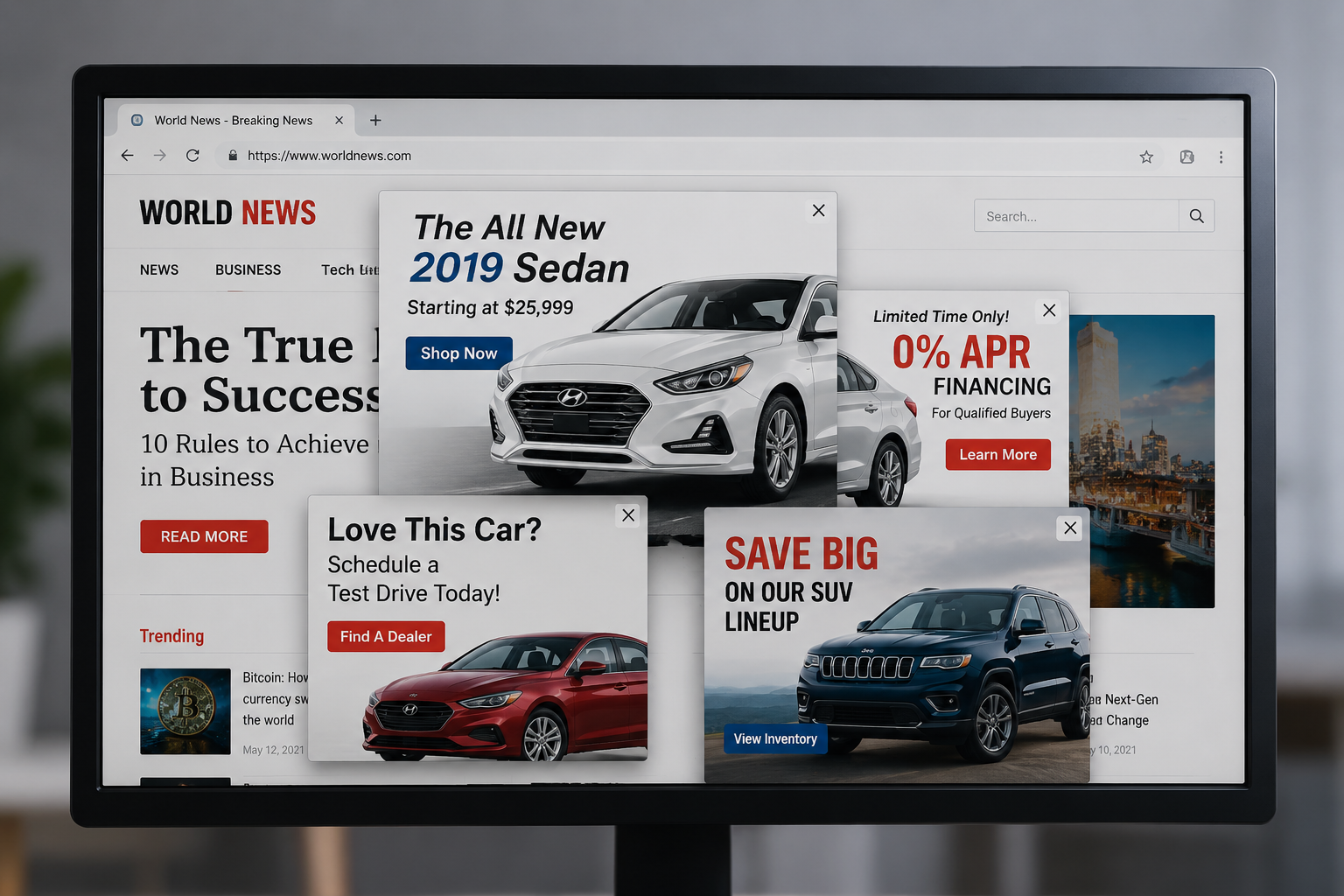
One example is dynamic inventory display. Here the creative auto-refreshes with vehicle photos, pricing, model information, and calls to action pulled from a dealer feed.
Another example is geo-conquesting around competing rooftops and service audiences. This works when the store wants to intercept nearby demand with market-level precision and then follow those shoppers across web inventory with dealership-specific offers.
The third example is CTV plus display retargeting. A household sees a connected TV ad, then receives follow-up display impressions while they continue researching vehicles online. That is why Demand Local also emphasizes how CTV enhances omnichannel strategies instead of treating display as a standalone line item.
Final Verdict
There is no single best programmatic display advertising option for every dealership. The strongest choice depends on which bottleneck is slowing your team down.
- For dealer groups and agencies that need a managed service partner, first-party Customer Data Portal activation, real-time inventory marketing, and non-modeled sales ROI, Demand Local is the strongest option.
- For in-house media teams or agency traders that want broad workflow control across channels, Basis Technologies is the better fit.
- For hyperlocal conquesting and addressable local-market planning, Simpli.fi makes more sense.
- For location-led awareness and visit-oriented campaigns, GroundTruth is a strong shortlist option.
- For automotive-specific operating models centered on dealership workflows, PureCars, Orbee, and Lotlinx each deserve consideration based on whether your priority is execution simplicity, data unification, or VIN-level inventory pressure.
If your primary need is a technology plus service partner that can connect dealership data, campaign execution, and verified outcome reporting, Demand Local is worth evaluating. Talk to our team →
Programmatic Display FAQs
What is programmatic display advertising?
Programmatic display advertising uses software to buy digital display inventory automatically across websites, apps, and connected channels using audience, bidding, and campaign rules. Instead of negotiating placements manually, the platform uses audience data, bidding logic, and campaign rules to decide which impression to buy and which creative to show in milliseconds.
How does programmatic display advertising work?
It works by evaluating each available impression in real time and bidding automatically when the audience, geography, budget, and creative rules align. For dealerships, the strongest setups also connect CRM audiences, DMS or inventory feeds, and attribution rules so the campaign can react to real buyer and vehicle signals instead of generic traffic data.
What Is Display vs. Programmatic?
Display advertising is the ad format, while programmatic advertising is the automated method used to buy, place, and optimize those ads. A dealership can run display ads through direct buys, but programmatic display advertising uses automated bidding and targeting to decide where and when those ads appear.
Does programmatic display work for car dealerships?
Programmatic display works for car dealerships when campaigns use dealership data, local-market targeting, and clear measurement tied to inventory, leads, or appointments. It tends to perform best when stores use it to support inventory movement, retarget high-intent shoppers, or coordinate display with channels like CTV, paid search, and geofencing.
What are examples of programmatic display advertising?
Common dealership examples include dynamic inventory ads, geo-conquesting around competing rooftops, and retargeting that follows connected TV exposure with display ads. The shared advantage is that the audience, message, and timing can all adjust automatically based on behavior, geography, or vehicle interest.
How Fast Can a Dealer Launch?
Launch timing depends on audience setup, creative production, and data connections, with feed-driven dealership campaigns usually taking longer than simple awareness buys. A simple audience and creative campaign can move quickly. A dealership programmatic display program tied to CRM audiences, DMS feeds, and real-time inventory marketing usually takes longer because the data connections and reporting logic need to be configured correctly upfront.
What Does It Cost a Dealership?
Total cost includes media spend, platform or service fees, creative production, data costs, and any measurement setup needed to prove results. That is why custom-quote providers can look similar on paper but create very different actual operating costs once audience data, dynamic creative, and reporting requirements are included.
Does a Dealer Need a Self-Serve DSP?
A self-serve DSP is not required when a managed service partner can handle setup, optimization, reporting, and dealership-specific execution effectively. A self-serve DSP makes sense when the store or agency already has media operators who can manage setup, optimization, reporting, and troubleshooting. Many dealerships get better outcomes from a managed service partner because the challenge is not just access to inventory. It is execution discipline across data, creative, pacing, and dealership reporting.
How do dealerships measure programmatic display ROI?
Dealerships measure programmatic display ROI through lead volume, appointments, showroom activity, VDP engagement, and sold-unit or revenue matchback data tracking. The exact measurement model depends on the platform, though the most decision-useful setups connect media delivery to first-party dealership data instead of relying only on click metrics.
What are practical dealer examples?
Practical dealership examples include dynamic inventory ads, competitor geo-conquesting, and display retargeting that adjusts to shopper behavior or vehicle interest. Each example works because the creative and targeting logic can adjust to the shopper’s market, behavior, or vehicle interest.
Which platform is best for agencies serving dealerships?
For agencies serving dealerships, the best platform depends on whether they need white-label managed execution or a self-serve trading workflow. Demand Local is the strongest fit for agencies that want white-label execution and dealership-specific reporting, while Basis Technologies and Simpli.fi are common self-serve benchmarks for teams with in-house media talent.
What Should a Dealer Ask Before Switching?
Dealers should ask a potential partner about data activation, CRM and DMS compatibility, inventory-aware creative, reporting methods, and day-to-day optimization ownership. Those questions usually reveal more than a feature checklist.
If you want to compare managed execution, first-party data activation, and dealership reporting requirements with your current setup, review your current partner’s inventory, attribution, and reporting workflow side by side before you switch.