

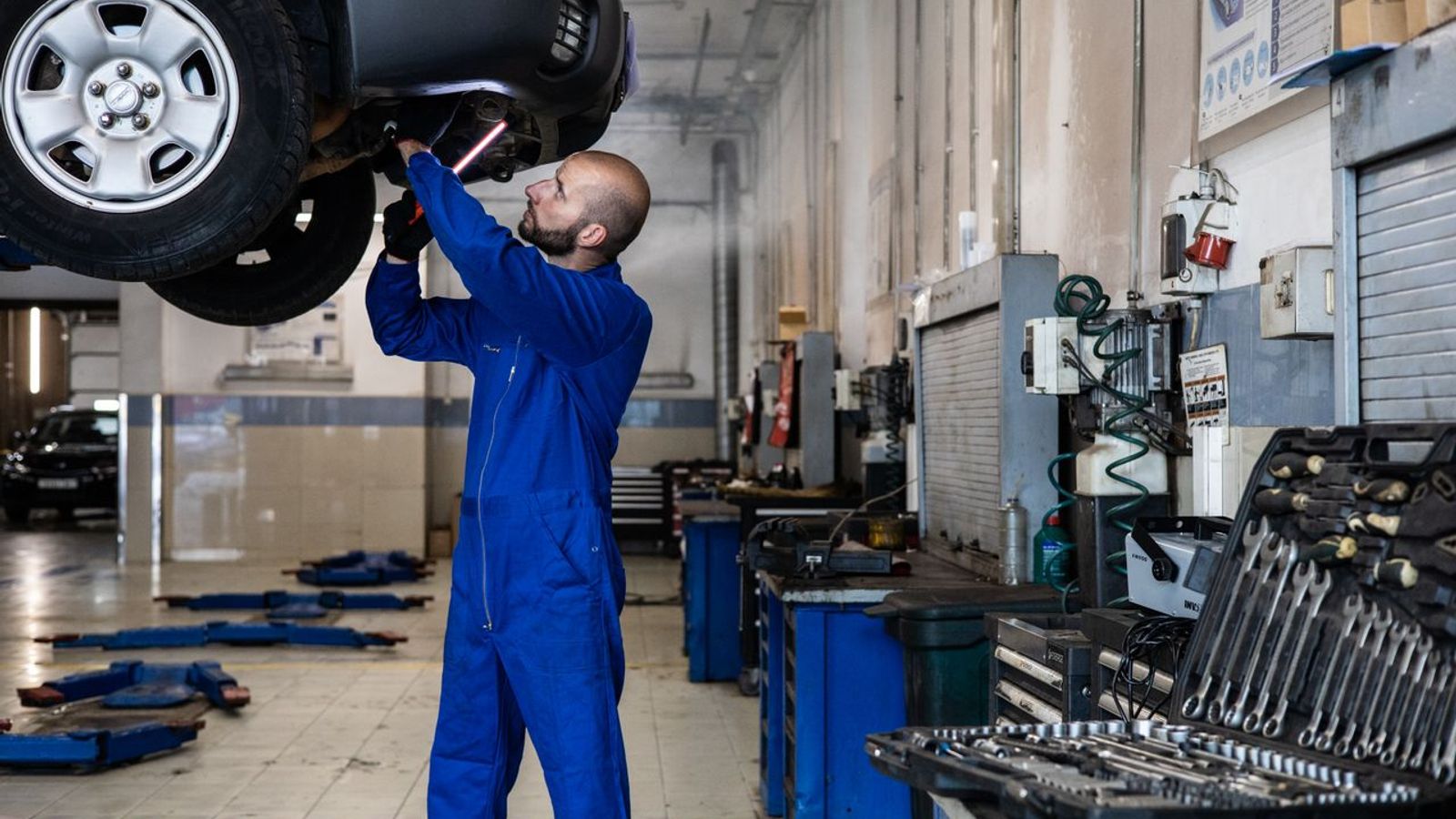
Comprehensive market data revealing growth opportunities, revenue benchmarks, and operational insights for multi-location automotive service operators
The global automotive repair and maintenance service market is estimated at $860 billion in 2026, creating substantial growth opportunities for multi-location service chains. Capitalizing on this market requires operators to coordinate marketing efforts across locations, unify fragmented customer data, and connect advertising investments to actual service transactions.
Platforms like Demand Local's LinkOne CDP help multi-location operators consolidate customer data from CRM and DMS systems into unified profiles, enabling targeted audience activation and closed-loop attribution to support more informed marketing decisions.
Key Takeaways
- Market expansion is accelerating: The global automotive repair market is growing at a 5.95% CAGR, projected to reach $1.15 trillion by 2031
- Larger firms capture substantial revenue: Firms with 20+ employees generated 39.5% of industry receipts in 2022 despite representing approximately 4% of employer firms
- Oil change businesses demonstrate multi-location potential: Oil-change and lubrication shops operate 8,694 locations across 4,269 firms, averaging more than two locations per business
- Franchise continuity remains strong: Franchise continuity rates remained stable at 94%, reflecting strong sector performance and sustainable business models
- Workforce demand continues growing: Automotive technician employment is projected to grow 5% from 2025 to 2035, adding about 40,900 jobs
- Data integration drives performance: With customer records fragmented across CRM, DMS, and marketing platforms, multi-location chains need unified data strategies to track marketing effectiveness and customer lifetime value
Projected Growth and Market Share for Multi-Location Auto Service Chains
The automotive repair and maintenance industry continues its steady expansion, driven by aging vehicle fleets, increasing technological complexity, and growing consumer reliance on professional service providers. For multi-location chains, this growth creates both opportunity and competitive pressure.
1. Global market valued at $860 billion in 2026
The global automotive repair and maintenance service market reached $860 billion in 2026, establishing the industry as one of the largest service sectors worldwide.
2. Market projected to reach $1.15 trillion by 2031
Industry analysts project the market will grow to $1.15 trillion by 2031, representing substantial expansion over five years.
3. 5.95% compound annual growth rate through 2031
The automotive repair sector is expanding at a 5.95% CAGR from 2026 to 2031, outpacing many traditional service industries.
4. Light duty aftermarket grew 5.7% in 2024
U.S. light-duty aftermarket sales expanded by 5.7% in 2024 to reach $413.7 billion.
5. Total aftermarket projected to reach $676.5 billion by 2029
The combined U.S. light-, medium-, and heavy-duty automotive aftermarket is projected to reach $676.5 billion by 2029, according to the Auto Care Association's 2027 Factbook, following projected growth of 5.4% in 2026.
6. North America commands 38.10% global market share
North America controlled 38.10% of the global automotive repair and maintenance market share in 2025, reflecting the region's mature vehicle fleet and service infrastructure.
Revenue Performance and Business Economics
Revenue varies substantially across automotive repair businesses of different sizes, with larger firms demonstrating higher average annual receipts. Understanding these revenue patterns helps operators benchmark performance and identify growth opportunities.
7. Industry generated $161 billion in U.S. receipts
The U.S. auto repair industry generated $161 billion in total receipts in 2022 from 149,164 employer firms.
8. Firms with 20+ employees average $10.5 million
Firms with 20 or more employees averaged $10.5 million each, generating $63.6 billion or 39.5% of total industry receipts despite representing only 4% of businesses.
9. Average revenue per location reaches $959,000
Across all 167,884 establishments, average revenue per location is approximately $959,000 annually.
10. Smaller firms earn 60.5% of industry revenue
Firms with fewer than 20 employees earn 60.5% of total revenue ($97.4 billion), representing the majority of industry receipts spread across 96% of all firms.
For multi-location operators seeking to maximize customer lifetime value, building unified customer profiles from service history and repair orders enables targeted reengagement campaigns that drive repeat visits across all locations.
Industry Structure and Business Counts
Understanding the competitive landscape requires examining how the industry splits between different business sizes and service segments. The data reveals the industry's fragmented structure and consolidation opportunities.
11. 149,164 employer firms operate 167,884 locations
The U.S. automotive repair and maintenance sector includes 149,164 employer firms operating 167,884 establishments.
12. Establishments outnumber employer firms by 18,720
The U.S. automotive repair and maintenance sector included 149,164 employer firms and 167,884 establishments in 2022, a difference of 18,720. This reflects additional establishments beyond one per firm, indicating some degree of multi-location ownership without establishing the exact number of chains or franchise operators.
13. 96% of firms have fewer than 20 employees
Nearly 96% of automotive repair firms have fewer than 20 employees, indicating the industry remains highly fragmented with consolidation opportunities.
14. Oil change shops average 2+ locations per firm
Oil-change and lubrication shops represent the most chain-driven segment, with 4,269 firms running 8,694 locations, more than two locations per firm on average.
15. General repair accounts for 79,429 firms
General automotive repair accounts for 79,429 firms and 84,101 locations, representing the largest segment by business count.
16. Body shops comprise 31,351 firms
Body, paint, and interior shops comprise 31,351 firms with 34,665 locations nationwide.
Franchise Industry Health and Unit Growth
Franchise continuity and unit growth metrics indicate industry health and investment attractiveness. These indicators inform expansion planning and franchise development strategies.
17. Franchise establishments reached five-year high
The franchised automotive services industry reached a five-year high of 17,774 total franchise establishments in 2022.
18. 41 new brands adopted franchise model
During 2018-2023, 41 new brands adopted the franchise business model in the automotive aftermarket services industry.
19. Franchise units grew at 1.2% CAGR
The average number of franchise units grew at 1.2% CAGR from 2021 to 2023, reaching approximately 18,000 units.
20. Franchise continuity rate remained at 94%
Franchise continuity rates remained stable at 94%, reflecting strong sector performance and sustainable business models.
For franchise operators tracking marketing effectiveness across multiple locations, Demand Local's aftermarket attribution connects advertising exposure to verified in-store service transactions, coupon redemptions, and revenue. This helps operators evaluate campaign performance using actual service activity rather than relying solely on clicks and impressions.
Workforce and Employment Trends
Labor availability and costs significantly impact multi-location service operations. Understanding workforce dynamics helps chains plan for staffing challenges and competitive compensation strategies.
21. Industry employs 958,913 workers
The U.S. auto repair industry employed 958,913 people in 2022, with continued growth projected.
22. 825,800 automotive technician jobs exist
Automotive service technicians and mechanics held approximately 825,800 jobs in the U.S. in 2025.
23. Technician employment growing 5% through 2035
Automotive technician employment is projected to grow 5% from 2025 to 2035, adding about 40,900 jobs.
24. Median technician pay reaches $50,620
The median annual wage for automotive service technicians and mechanics was $50,620 ($24.34 per hour) in 2025.
Demand Local: Unified Data and Measurable Marketing for Multi-Location Service Chains
Multi-location automotive service chains face distinct marketing challenges, from fragmented customer records and inconsistent audience targeting to complex attribution across locations. Demand Local's LinkOne platform addresses these challenges by connecting customer data, audience intelligence, media activation, and transaction-level attribution within a unified platform.
Demand Local helps multi-location automotive service chains improve marketing effectiveness through the following capabilities:
- Unified customer data: Consolidate fragmented customer records from CRM and DMS systems through first-party data integration, creating unified customer profiles that help operators understand customer behavior and cross-location visit patterns.
- Targeted customer reengagement: Build audience segments using repair order history, maintenance intervals, and available vehicle data to deliver relevant messaging that encourages repeat service visits.
- Omnichannel media activation: Connect first-party audiences to advertising channels through media activation capabilities, including connected TV, streaming audio, display, and digital out-of-home, with frequency controls where supported by participating platforms.
- Transaction-level attribution: Connect advertising exposure to matched service transactions, coupon redemptions, and revenue through closed-loop attribution, helping operators evaluate campaign performance beyond clicks and impressions.
- Data-driven budget allocation: Use audience insights and matched transaction data to inform campaign optimization, identify performance trends, and allocate marketing budgets across locations and advertising channels.
- White-label agency reporting: Enable agency partners serving multi-location automotive service businesses to present campaign performance and attribution insights under their own branding.
Demand Local gives multi-location automotive service chains the tools to turn fragmented customer data into actionable audience insights, coordinated advertising campaigns, and measurable business outcomes. This integrated approach helps operators strengthen customer retention, encourage repeat service visits, and make more informed advertising investments across their locations.
Request a demo to discover how Demand Local can support data-driven marketing across multi-location automotive service businesses.
Frequently Asked Questions
How can multi-location auto service chains accurately measure the ROI of their marketing spend in 2027?
Multi-location service chains can implement closed-loop attribution to match DMS-verified service transactions to advertising exposure across supported channels. This approach goes beyond click-based metrics to connect actual revenue to campaign activity. Where supported, returning verified transactions to advertising platforms as conversion signals can help campaign algorithms optimize toward business outcomes. These insights can inform targeting adjustments, customer acquisition strategies, and marketing budget allocation.
What role will Customer Data Platforms play in consolidating customer data for auto service networks?
CDPs such as Demand Local's LinkOne platform enable multi-location operators to unify fragmented customer records from CRM, DMS, and marketing systems into single customer profiles. By consolidating duplicate records across locations, CDPs support customer lifetime value calculations and personalized marketing. Building unified customer profiles from service history allows chains to identify customers approaching recommended service milestones or driving vehicles requiring specific maintenance. This consolidated view helps operators deliver more consistent customer experiences across locations.
How can service centers reengage past customers effectively using advanced data analytics?
Service chains can build targeted customer audiences from repair order history, service intervals, and available vehicle age data stored in their business systems. By identifying customers approaching recommended service milestones, chains can deliver personalized offers that encourage timely return visits. Demand Local's aftermarket service solutions support CRM data activation across advertising channels, including connected TV, display, and streaming audio. This data-driven reengagement approach helps service chains deliver more relevant messaging and encourage repeat business.
How does privacy-conscious identity resolution impact marketing for multi-location auto service chains?
Privacy-conscious identity resolution helps multi-location service chains connect customer records to advertising exposure while limiting unnecessary sharing of personal information. Technologies such as Demand Local's clean-room matching capabilities support controlled data processing within secure environments. Organizations remain responsible for meeting applicable consent, privacy, and data protection requirements regardless of the technologies used. This balanced approach supports marketing effectiveness while respecting customer data protection expectations.
Can agencies white-label attribution reports for their auto service chain clients?
Yes, Demand Local supports white-label reporting, allowing agencies to present campaign results under their own branding. For automotive service chains, reporting can include matched in-store transactions, coupon redemptions, and revenue to help evaluate marketing ROI. Vehicle-sales campaigns can use VIN-level attribution when supported by available sales data. This white-label capability allows agencies to demonstrate marketing performance to clients while maintaining consistent brand presentation across their client portfolio.